
Japanese maple (Acer palmatum)
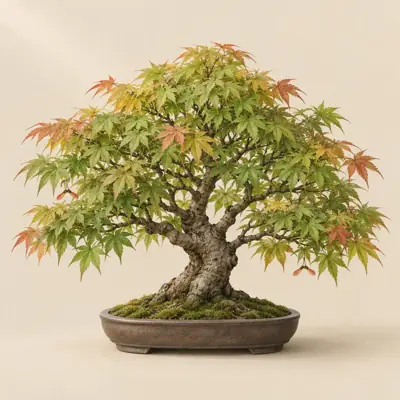
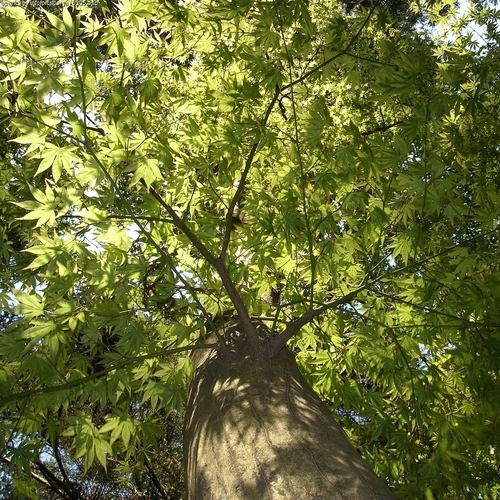
Acer palmatum is a perennial deciduous woody plant, ranging in habit from a shrub to a small tree. Its crown may be spreading, low and rounded, or dome-shaped at maturity, while cultivars may also have upright or weeping forms.
Overview
Acer palmatum is a perennial deciduous woody plant, ranging in habit from a shrub to a small tree. Its crown may be spreading, low and rounded, or dome-shaped at maturity, while cultivars may also have upright or weeping forms.
Origin and habitat
Acer palmatum is native to East Asia, with Japan, the Korean Peninsula, and China forming its core native range; sources differ, with some also including Taiwan, eastern Mongolia, and the Russian Far East. It occurs in woodland, scrub, and environments from low hills to mountains, and plants in some native habitats are often found in shaded forest understories. It is a cold-tolerant plant of temperate Asia, although new shoots and leaves may be damaged by late frost.
Characteristics
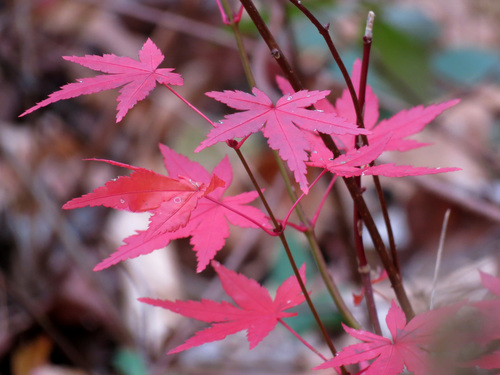
Sources differ on mature height, placing it at about 400–800 cm; a single source reports a mature spread of about 400–800 cm. Growth is generally reported to be slow to moderate. Sources differ in descriptions of the opposite, palmately lobed leaves, which have multiple pointed lobes and serrated or doubly serrated margins; they may turn yellow, orange, or red in autumn, and flowering occurs in spring near the emergence of new leaves, with timing varying by location. The small flowers are reported to have red to purple sepals and pale petals and may occur in small cymose or corymb-like clusters; the fruits are paired winged samaras that may be red or green and can be dispersed by wind when mature.
Light
Sources support conditions from full sun to partial shade, though dappled light or partial shade is more commonly recommended; strong exposure combined with insufficient soil moisture may cause leaf scorch.
Watering
Keep the soil moist but well drained, provide additional water in summer when needed, and avoid waterlogging.
Temperature and dormancy
Sources differ on minimum temperature, with limited evidence placing it at about -25 °C. Acer palmatum is frost hardy. Sources also describe its hardiness using USDA and RHS classifications.
Growing medium and mounting
Acer palmatum prefers moist, well-drained soil and can adapt to clay, loam, or sand, with acidic to neutral conditions being more suitable. Alkaline soil may lead to chlorosis associated with iron deficiency.
Propagation
Acer palmatum can be propagated by grafting or softwood cuttings; propagation from seed requires stratification to promote germination.
Common problems
Potential pests include aphids, maple gall mites, caterpillars, scale insects, and Japanese maple leafhoppers. Verticillium wilt, maple leaf scorch, and diseases associated with honey fungus are reported as possible diseases. Insufficient soil moisture or excessive exposure may cause leaf scorch, while alkaline soil may cause chlorosis associated with iron deficiency. Tender spring buds and new shoots and leaves may be damaged by late frost, and cold or dry strong winds should be avoided.
Identification
Palmately divided leaves are a prominent feature, and the autumn foliage often has vivid coloration. The species is highly variable, with cultivars differing greatly in habit, leaf shape, and color and including upright and weeping forms.
Photos


Sources
- Wikipedia (en): Acer palmatum — CC BY-SA 4.0 · link
- 維基百科:鸡爪槭 — CC BY-SA 4.0 · link
- Wikipedia (ja): イロハモミジ — CC BY-SA 4.0 · link
- Wikipedia (de): Fächer-Ahorn — CC BY-SA 4.0 · link
- Wikipedia (fr): Érable palmé — CC BY-SA 4.0 · link
- GBIF descriptions: Manual of the Alien Plants of Belgium; The Woody Plants of Korea (한국의 수목); Database of Vascular Plan — per dataset · link
- NC State Plant Toolbox: Acer palmatum — copyright (facts only) · link
- Wikipedia (nl): Japanse esdoorn — CC BY-SA 4.0 · link
- Wikipedia (pt): Acer palmatum — CC BY-SA 4.0 · link
- Useful Tropical/Temperate Plants: Acer palmatum — CC BY-NC-SA 3.0 (facts only) · link
- RHS Plants: Acer palmatum — © RHS, facts only · link
- USDA PLANTS Database: Acer palmatum — Public domain (US Government work) · link
- Top Tropicals catalog: Acer palmatum — © Top Tropicals LLC (facts only) · link