
Adenia venenata (Adenia venenata)
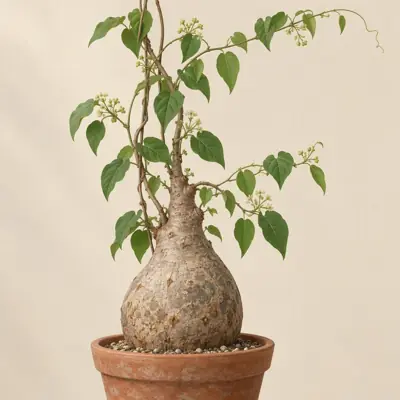
Adenia venenata is a semi-succulent climbing vine with a stout, tuber-like stem base resembling a shrub or small tree and twining branches that can climb. It is reported to be perennial.
Overview
Adenia venenata is a semi-succulent climbing vine with a stout, tuber-like stem base resembling a shrub or small tree and twining branches that can climb. It is reported to be perennial.
Origin and habitat
Sources differ on the native range, describing it as extending across parts of sub-Saharan Africa, the Horn of Africa and East Africa, explicitly including Nigeria, Tanzania, Uganda, Djibouti, Eritrea, Ethiopia and Somalia and extending to Yemen, while other accounts describe it more broadly as tropical Africa or from Yemen to Kenya. It occurs in dry forest, savanna, deciduous scrub or open woodland, and open rocky scrub, on substrates including sand, clay, volcanic soils, basalt and limestone. Its natural distribution includes tropical Africa, East Africa and drier savanna and scrub environments, and it is drought tolerant.
Characteristics
Mature plants range from 100–800 cm in height and have a mature spread of 60 cm. The plant has a swollen stem and a stout, enlarged main stem base. The deciduous leaves are nearly round to ovate in outline, shallowly to deeply lobed, with a heart-shaped base and rounded tip; their undersides are gray-green to somewhat powdery, and the leaves fall during dormancy. Flowers are creamy white or yellow-green and may also be reddish, forming small cymes; the fruit is reported to be an ovate to elliptic capsule with a relatively pointed tip, leathery skin and conspicuous veins, containing multiple seeds.
Light
Provide strong light, full sun or bright indoor light, while avoiding excessively intense exposure during hot summers.
Watering
During growth, water and then allow the growing medium to dry thoroughly before watering again; the plant tolerates drought. While in leaf, water when the mix has dried, and during periods of non-growth and winter keep it substantially drier. While leafless, it is reported that water should be withheld.
Temperature and dormancy
The few available sources report a minimum of about 5 °C. Sources differ on its hardiness-zone classification. It is reported to tolerate brief light frost. It drops its leaves and goes dormant, and cold is reported to trigger dormancy.
Growing medium and mounting
For container culture, use a well-drained medium; succulent cultivation calls for a granular, fast-draining mix. It needs a fast-draining mix.
Feeding
A balanced fertilizer is reported to be suitable during the growing season.
Propagation
Propagation can be by seed or herbaceous cuttings, with cut surfaces allowed to dry thoroughly before planting. Genus-level information indicates that cuttings of some Adenia may not readily form a caudex.
Common problems
In cold regions it should be moved indoors in winter, and maintaining relatively high moisture during dormancy or low temperatures is contrary to the recommended drier management. Sources differ on cold sensitivity: freezing should be avoided and protection with reduced watering is advised in cold periods, while another source reports tolerance of brief light frost.
Identification
The most conspicuous feature is the bottle-shaped, fleshy, swollen green stem base, which produces slender, somewhat powdery, twining climbing branches ranging from few to many.
Sources
- Wikipedia (en, genus): Adenia — CC BY-SA 4.0 · link
- Wikipedia (es): Adenia venenata — CC BY-SA 4.0 · link
- LLIFLE Encyclopedia of living forms: Adenia venenata — CC BY-SA · link
- Desert-Tropicals: Adenia venenata — © Philippe Faucon (desert-tropicals.com), facts only · link
- The Succulent Plant Page: Adenia (genus-level) — © R.J. Hodgkiss, facts only · link
- Top Tropicals catalog: Adenia venenata — © Top Tropicals LLC (facts only) · link
- Adenia venenata | Giromagi cactus and succulents for sale | Buy plants online (www.giromagi.com) — facts only (§12) · link
- PUKUBOOK: Adenia venenata — CC BY-NC (facts only) · link