
Adenium arabicum (Adenium arabicum)
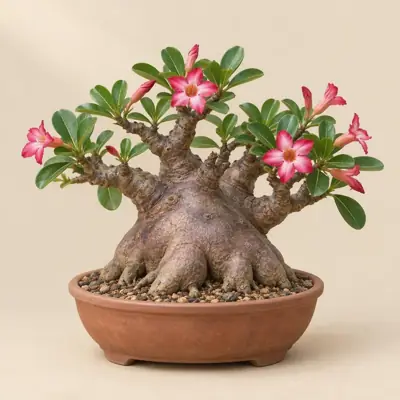
Adenium arabicum is a succulent, shrubby perennial with a conspicuously swollen caudex, typically forming a low, stout plant that branches near the top. It is perennial and usually deciduous, but may remain nearly evergreen under warm conditions with continuous water.
Overview
Adenium arabicum is a succulent, shrubby perennial with a conspicuously swollen caudex, typically forming a low, stout plant that branches near the top. It is perennial and usually deciduous, but may remain nearly evergreen under warm conditions with continuous water.
Origin and habitat
Sources differ on its native range, which is described as the southern Arabian Peninsula, mainly Yemen and Saudi Arabia. It is reported to grow in extremely dry environments among granite rocks and cliffs. It is adapted to dry to semi-arid, sunny and drought-prone climates, with high drought tolerance but poor frost tolerance.
Characteristics
Sources differ, but mature height is reported at about 100–150 cm; a single source similarly reports a spread of about 100–150 cm. The plant has a swollen stem and is described as stout; its leaves are relatively large, thick, fleshy to leathery, obovate to spoon-shaped, entire and hairless, with glossy dark-green upper surfaces and paler undersides, and they are often clustered near branch tips and may fall during the dry season. Sources differ in descriptions of its conspicuous flowers and flowering: flowers are often clustered at branch tips, with a tubular corolla that flares outward, are mainly pink to carmine, may appear before new leaves, and flowering may occur throughout the year under suitable conditions, with more abundant bloom during drier periods in spring and autumn and occasional winter flowers. The fruit is reported to consist of paired follicles joined at the base, which split along one side at maturity and release many seeds.
Light
Sources differ somewhat, but Adenium arabicum prefers full sun or a very bright position; in glasshouse cultivation, some shade may be provided under intense, hot sun.
Watering
During growth, water thoroughly after the growing medium dries and avoid prolonged wetness; while in leaf, water when the mix has dried. During cool winter dormancy, greatly reduce or stop watering, and withhold water while leafless. One source reports a winter watering interval of about 30–90, so sources are few.
Humidity and airflow
A single source reports that Adenium arabicum prefers high humidity and needs good airflow.
Temperature and dormancy
Adenium arabicum drops its leaves and goes dormant, with dormancy triggered by cold, and it has high heat tolerance. Its cold minimum is 5 °C. Sources differ, with limited evidence reporting a minimum of about 5 °C. A single source generally places it in the stated USDA hardiness range and reports that it tolerates brief light frost.
Growing medium and mounting
Adenium arabicum needs a very fast-draining growing medium; loam or sandy media can be amended with coarse sand, pumice, perlite or similar materials to increase pore space and drainage.
Feeding
During active growth, it is reported to benefit from regular feeding, with greater emphasis on potassium, phosphorus and trace elements while avoiding excessive nitrogen to encourage development of the swollen base and flowering.
Propagation
Adenium arabicum can be propagated by seed or cuttings; seeds are sown after maturing, and non-flowering shoots can be used as cuttings. Seed-grown plants tend to form a thicker stem base more readily, while plants from cuttings usually develop less conspicuous basal swelling.
Common problems
Possible pests include aphids, spider mites and root mealybugs. Excess moisture or cold conditions may lead to soft rot or root rot, while poor drainage or excessive winter watering can also promote rot. Drought or cold can cause leaf drop, although this may also be a normal dormancy response. It tolerates heat and drought but is sensitive to low temperatures and cold, wet winter conditions; young plants are particularly vulnerable to frost.
Identification
Adenium arabicum has a very stout, low and conspicuously swollen caudex base, with little distinction between the main trunk and branches; short branches are often twisted, and the bark or surface may range from gray-green or brown to dark brown or purplish. Compared with A. obesum, it is often described as having a stouter caudex and thicker, larger leaves.
Photos


Sources
- GBIF Backbone: Adenium arabicum Balf.fil. — CC BY 4.0 · link
- Wikipedia (en): Adenium arabicum — CC BY-SA 4.0 · link
- LLIFLE Encyclopedia of living forms: Adenium arabicum — CC BY-SA · link
- Useful Tropical/Temperate Plants: Adenium arabicum — CC BY-NC-SA 3.0 (facts only) · link
- RHS Plants: Adenium arabicum — © RHS, facts only · link
- NHK みんなの趣味の園芸 植物図鑑: Adenium arabicum — © NHK出版, facts only · link
- NC State Plant Toolbox: Adenium (genus-level) — copyright (facts only) · link
- Top Tropicals catalog: Adenium arabicum — © Top Tropicals LLC (facts only) · link
- PUKUBOOK: Adenium arabicum — CC BY-NC (facts only) · link
- Adenium arabicum | Giromagi cactus and succulents for sale | Buy plants online (www.giromagi.com) — facts only (§12) · link