
desert-rose (Adenium obesum)
Adenium obesum is a perennial succulent shrub to small tree with a swollen root or stem base; sources differ on whether it remains evergreen or sheds its leaves in response to drought or cold.
Overview
Adenium obesum is a perennial succulent shrub to small tree with a swollen root or stem base; sources differ on whether it remains evergreen or sheds its leaves in response to drought or cold.
Origin and habitat
Sources differ on its native range, describing dry regions of Africa from the western Sahel through East Africa and tropical and subtropical eastern and southern Africa, extending to the Arabian Peninsula, with Socotra populations also involved under some taxonomic treatments. It occurs in dry to semiarid environments, including sandy or rocky areas, savanna, dry scrub, and open woodland. It is adapted to dry and semiarid tropical to subtropical climates; some native areas have wetter summers and very dry winters, and the plant has pronounced drought tolerance.
Characteristics
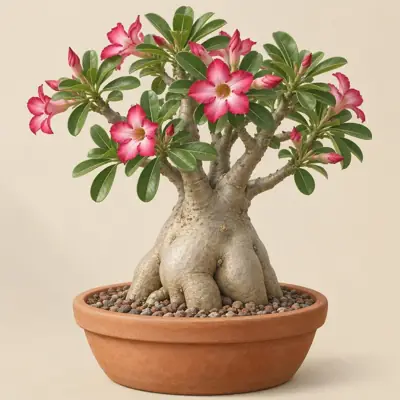
Sources differ on mature height, placing it at about 100–600 cm, while a single source reports a mature spread of about 100–150 cm. Sources differ in descriptions of the leaves, which are simple, entire, leathery, green to dark green with a usually paler underside, and mainly clustered in a spiral arrangement near branch tips. The flowers are tubular to funnel-shaped, usually with a lobed corolla, mainly pink to red but also white, and are mostly borne near branch tips; sources differ on when flowering occurs, describing it mainly from spring through autumn and noting that climate and cultivation temperature can affect and, in a warm greenhouse, extend flowering. Adenium obesum has a thickened trunk (pachycaul), and its fruit is reported to be slender, green, and pod-like, splitting at maturity to release seeds with tufts of hair at their ends.
Light
Sources differ somewhat in their descriptions, but full sun to bright, strong light is preferred and ample sunlight favors flowering; in a hot glasshouse, intense sunlight may be moderately shaded.
Watering
During the growing period, water thoroughly after the growing medium has dried and avoid waterlogging; the plant is drought tolerant, and watering should be greatly reduced or stopped during cold winter conditions or dormancy. While in leaf, water when the mix has dried, and withhold water while leafless.
Humidity and airflow
A single source generally reports that Adenium obesum prefers high humidity and needs good airflow.
Temperature and dormancy
Sources differ on minimum temperature guidance, with a reported minimum of about 5 °C; another cross-source claim gives a cold minimum of 5 °C. Sources differ on hardiness-zone descriptions, while the plant is frost tender; keep above freezing. It drops its leaves and goes dormant, with dormancy triggered by cold, and it has high heat tolerance. A single source reports an active-temperature range of about 23.9–35, so sources for this range are few.
Growing medium and mounting
Adenium obesum needs a very fast-draining mix; suitable media include sandy loam, cactus and succulent mix, or potting mix combined with coarse sand, and it can adapt to loam, sand, and neutral to alkaline conditions.
Feeding
It can be fertilized during the growing season; sources variously recommend feeding in spring, small amounts of slow-release fertilizer from spring through autumn, or low-dose liquid fertilizer during growth, while Taipei Collectible Botanical Garden recommends a long-lasting, relatively high-potassium fertilizer once each season from spring through autumn.
Propagation
Adenium obesum can be propagated by sowing or cuttings, with air layering and grafting also reported; seedlings more readily develop a thickened stem base, while plants from cuttings usually develop a less swollen base. Cuttings are a supported propagation method.
Common problems
Potential pests include scale insects, mealybugs, root mealybugs, aphids, and spider mites. Southern blight and soft rot have been reported, with excessive moisture and cold increasing soft-rot problems. Overwatering or poor drainage can readily cause rot, insufficient light can reduce flowering, and cold can cause yellowing leaves, leaf drop, and shoot-tip injury. It does not tolerate frost or low temperatures; cold winter conditions can lead to leaf loss and dormancy, while its tolerance of high temperatures is stronger.
Identification
Its most conspicuous features are a thick, swollen stem base or tuber-like trunk, clusters of leaves at branch tips, and large, brightly colored funnel-shaped flowers; the base is especially stout in older plants.
Photos


Sources
- Wikipedia (en): Adenium obesum — CC BY-SA 4.0 · link
- 維基百科:沙漠玫瑰 (植物) — CC BY-SA 4.0 · link
- NC State Plant Toolbox: Adenium obesum — copyright (facts only) · link
- Wikipedia (ja): アデニウム・オベスム — CC BY-SA 4.0 · link
- Wikipedia (de): Adenium obesum — CC BY-SA 4.0 · link
- Wikipedia (fr): Rose du désert — CC BY-SA 4.0 · link
- Wikipedia (es): Adenium obesum — CC BY-SA 4.0 · link
- LLIFLE Encyclopedia of living forms: Adenium obesum — CC BY-SA · link
- Useful Tropical/Temperate Plants: Adenium obesum — CC BY-NC-SA 3.0 (facts only) · link
- RHS Plants: Adenium obesum — © RHS, facts only · link
- Desert-Tropicals: Adenium obesum — © Philippe Faucon (desert-tropicals.com), facts only · link
- The Succulent Plant Page: Adenium (genus-level) — © R.J. Hodgkiss, facts only · link
- 臺北典藏植物園 植物資料庫: Adenium obesum — © 臺北典藏植物園, facts only · link
- NHK みんなの趣味の園芸 植物図鑑: Adenium obesum — © NHK出版, facts only · link