
delta maidenhair (Adiantum raddianum)
Adiantum raddianum is a perennial herbaceous fern that may grow terrestrially or on rock, with a short, creeping, branching rhizome and a clumping habit.
Overview
Adiantum raddianum is a perennial herbaceous fern that may grow terrestrially or on rock, with a short, creeping, branching rhizome and a clumping habit.
Origin and habitat
Sources differ on its native range, describing it as native to tropical America, including South America and the West Indies. It is associated mainly with tropical American environments and favors warm, humid, shaded conditions; in temperate regions it is commonly grown indoors or in greenhouses.
Characteristics
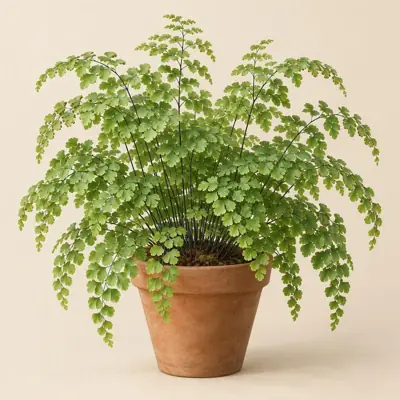
Mature spread is 30–60 cm. Sources differ in their descriptions of the fronds, which range from triangular to elongated triangular or ovate-lanceolate, are divided into multiple pinnate divisions, and have fan-shaped to wedge-shaped pinnules with lobed or finely toothed margins. The slender stipes and rachises are dark to black and glossy; young fronds may be more upright, while mature fronds often arch downward. It has a creeping rhizome.
Light
Sources differ somewhat, but bright indirect light to partial shade is described as most suitable; it can tolerate shadier positions, although excessive shade can reduce vigor, and sudden exposure to strong direct sunlight should generally be avoided.
Watering
Keep the growing medium evenly moist but well drained, without allowing the roots or medium to dry out completely; provide more water from spring through autumn, wait until the surface begins to dry before watering in winter, and avoid prolonged waterlogging.
Humidity and airflow
Adiantum raddianum prefers high humidity and needs moderate airflow.
Temperature and dormancy
A minimum of about 5 °C is reported, but this figure comes from few sources. It is generally reported for a warm hardiness zone, although the available zone information comes from a single source. It is tender.
Growing medium and mounting
Use a humus-rich, moist but well-drained medium; sources support either loam or a general indoor-plant potting medium, with neutral to slightly alkaline conditions preferred.
Feeding
During the growing season, regular light feeding is supported, with sources describing diluted general liquid fertilizer as well as slow-release or liquid feeding schedules.
Propagation
Propagation can be by division or by sowing spores; sources recommend sowing mature spores promptly and describe rhizome division at suitable times that differ between sources. Spores are borne beneath reflexed lobes along the frond margins and are reported to be suitable for sowing once mature.
Common problems
Sources differ on pest problems, reporting scale insects, mealybugs, Florida fern caterpillar, and slugs that may damage tender fronds. Sources mention damping-off or wilt-type diseases and overly wet conditions as a possible factor, while another source reports no significant disease problems in general. Dry growing medium can impair growth, strong light may scorch the fronds, and sudden environmental changes may damage them. It does not tolerate low temperatures well; in temperate regions it is advised to be moved indoors during winter and kept away from direct heating or cooling airflow.
Identification
It is reported to have slender, glossy black stipes and rachises and fan-shaped to triangular pinnules, with sori along the frond margins covered by false indusia formed from the reflexed margins.
Photos


Sources
- GBIF Backbone: Adiantum raddianum C.Presl — CC BY 4.0 · link
- Wikipedia (en): Adiantum raddianum — CC BY-SA 4.0 · link
- Wikipedia (ja): コバホウライシダ — CC BY-SA 4.0 · link
- GBIF descriptions: Manual of the Alien Plants of Belgium; Catálogo de Plantas y Líquenes de Colombia; DAISIE - Inventor — per dataset · link
- NC State Plant Toolbox: Adiantum raddianum — copyright (facts only) · link
- Wikipedia (nl): Fijn venushaar — CC BY-SA 4.0 · link
- RHS Plants: Adiantum raddianum — © RHS, facts only · link
- USDA PLANTS Database: Adiantum raddianum — Public domain (US Government work) · link
- 臺北典藏植物園 植物資料庫: Adiantum raddianum — © 臺北典藏植物園, facts only · link
- NHK みんなの趣味の園芸 植物図鑑: Adiantum raddianum — © NHK出版, facts only · link