
Manila palm (Adonidia merrillii)
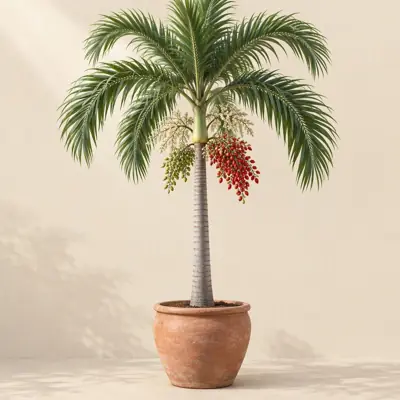
Adonidia merrillii is a perennial evergreen palm with an upright, single-trunked habit.
Overview
Adonidia merrillii is a perennial evergreen palm with an upright, single-trunked habit.
Origin and habitat
Adonidia merrillii is native to the Philippines, especially Palawan; sources differ on whether Borneo or Sabah, Malaysia, is also within its native range. It is reported to occur in open coastal forests and can grow on steep limestone slopes. It occurs in tropical to warm, frost-free environments, is widely cultivated in tropical regions, and can also be grown in warm subtropical conditions.
Characteristics
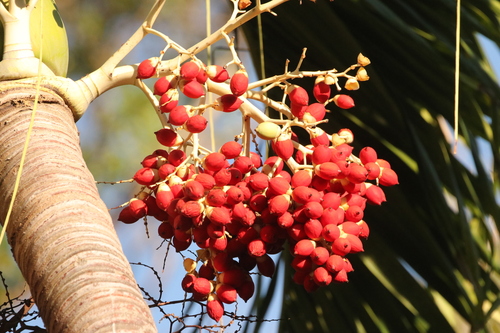
Sources differ on mature height, placing it at about 370–1000 cm; the few available sources report a mature spread of about 100–150 cm. Sources differ on its growth rate, but describe rapid early growth followed by slower growth. The green, pinnately compound leaves are arching or drooping, form a crown on mature plants, and may shed themselves after dying; the white to creamy-white flowers occur in branched inflorescences below the crown, and the plant bears both male and female flowers. It is reported to flower in mid-summer, while its ovoid drupes change from green when immature to bright red when ripe and are often red near the end of the year or in winter.
Light
It grows in full sun to partial sun; indoors, bright indirect light or partial sun is suitable.
Watering
Water regularly and keep conditions moist but well drained, avoiding waterlogging; it can tolerate short periods of drought.
Temperature and dormancy
The few available sources report an ideal temperature of about 18–28 °C and a minimum of about 15 °C. Its hardiness is described as USDA zone 10a or above and RHS rating H1A.
Growing medium and mounting
It adapts to various soils, with moist, well-drained soil preferred; loam and sandy soil are listed, and acidic, neutral, or alkaline conditions can be suitable.
Feeding
Indoor plants can be given houseplant fertilizer in spring and summer, while palm fertilizer can be used in nutrient-poor soil.
Propagation
It can be propagated from seed, with seed soaking before sowing recommended by RHS.
Common problems
Potential pests include greenhouse thrips, root mealybugs, fern scale, aphids, greenhouse red spider mites, and mealybugs. It is susceptible to lethal yellowing, a phytoplasma disease. Boron deficiency can occur; excessive shade can produce thinner, weaker trunks and leaves, and waterlogged conditions are unsuitable. It is highly sensitive to cold and does not tolerate frost, subzero temperatures, or cold winds; sources differ on its tolerance of salt or sea winds.
Identification
Adonidia merrillii has a slender, smooth, gray, ringed single trunk topped by a crown of arching, drooping pinnate leaves, while mature fruits form bright red clusters that often develop their color around Christmas.
Photos


Sources
- Wikipedia (en): Adonidia merrillii — CC BY-SA 4.0 · link
- Wikipedia (fr): Adonidia merrillii — CC BY-SA 4.0 · link
- Wikipedia (es): Adonidia merrillii — CC BY-SA 4.0 · link
- GBIF descriptions: Listado de especies de plantas usadas por la avifauna en sitios priorizados de la ciudad de Barranqu — per dataset · link
- NC State Plant Toolbox: Adonidia merrillii — copyright (facts only) · link
- Useful Tropical/Temperate Plants: Adonidia merrillii — CC BY-NC-SA 3.0 (facts only) · link
- RHS Plants: Adonidia merrillii — © RHS, facts only · link