
Adromischus cooperi (Adromischus cooperi)
Adromischus cooperi is a small, compactly clumping, nearly stemless succulent that can develop a thick, fleshy stem and become somewhat shrubby with age. It is a perennial evergreen succulent.
Overview
Adromischus cooperi is a small, compactly clumping, nearly stemless succulent that can develop a thick, fleshy stem and become somewhat shrubby with age. It is a perennial evergreen succulent.
Origin and habitat
Sources differ on its native range: it is native to South Africa's Eastern Cape, while some accounts extend the range to Lesotho and Eswatini. Its habitat includes mountainous areas of the Eastern Cape, with Noorsveld specifically recorded by another source. Rainfall in its native environment is reported to occur mainly in spring and autumn.
Characteristics
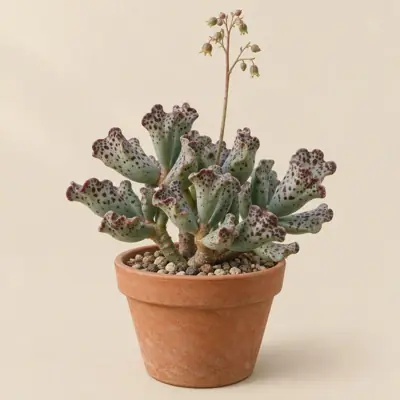
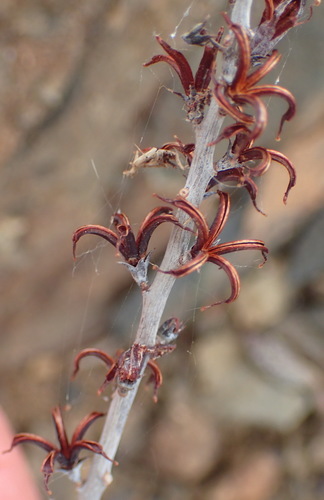
Sources differ on mature height, placing it at about 7–10 cm, while the few sources for mature spread report about 10–50 cm. It grows slowly and stores water in its leaves. The leaves are very thick and fleshy, narrower at the base, and gray-green to dark green or olive green; their tips are often wavy, with purple, brown, or red spots that become more pronounced, along with red coloration, under strong light. Sources differ in describing the small, tubular pink-to-red flowers as borne on upright flower stalks or racemes; flowering occurs from summer to midsummer.
Light
Sources differ: it is mainly described for abundant sunlight to full sun, with high light encouraging darker leaf markings, while another source recommends bright partial sun. Adromischus cooperi takes full sun.
Watering
Sources agree on using a well-drained medium and watering after the soil dries during the growing season; it tolerates drought and should be kept dry in winter, while descriptions of summer watering differ. The reported winter watering interval is 30–90 days.
Humidity and airflow
It is reported to need good airflow.
Temperature and dormancy
The few sources differ on a minimum temperature of about -2 °C. It is reported as hardy under USDA and RHS classifications, and it tolerates brief light frost. It is reported to rest in winter. A limited source reports a cold minimum of about -2 °C.
Growing medium and mounting
A fast-draining cactus or succulent medium is suitable; loam or sandy soil can be used, and sources report adaptation to acidic, neutral, or alkaline pH. It is reported to need a very fast-draining mix.
Propagation
It can be propagated by leaf cuttings, stem cuttings, or seed, with leaves especially prone to rooting.
Common problems
Possible pests include mealybugs and aphids, while genus-level cultivation information also mentions weevils. Disease is generally uncommon; genus-level information notes that floral nectar may encourage fungal infection, including gray mold particularly late in the growing season. Without sufficient light, the ornamental leaf markings and colors are less pronounced; during drought the leaves wrinkle and can plump up again after watering. It should be kept dry in winter and protected from prolonged frost, while sources vary widely on the minimum temperature it can withstand.
Identification
Its thick leaves with wavy tips and purple, brown, or red spots are key identifying features, and the markings become more pronounced under stronger sunlight.
Photos


Sources
- Wikipedia (en): Adromischus cooperi — CC BY-SA 4.0 · link
- Wikipedia (fr): Adromischus cooperi — CC BY-SA 4.0 · link
- Wikipedia (es): Adromischus cooperi — CC BY-SA 4.0 · link
- RHS Plants: Adromischus cooperi — © RHS, facts only · link
- Desert-Tropicals: Adromischus cooperi — © Philippe Faucon (desert-tropicals.com), facts only · link
- The Succulent Plant Page: Adromischus (genus-level) — © R.J. Hodgkiss, facts only · link
- Adromischus cooperi | Giromagi cactus and succulents for sale | Buy plants onlin (www.giromagi.com) — facts only (§12) · link
- PUKUBOOK: Adromischus cooperi — CC BY-NC (facts only) · link