
urnplant (Aechmea fasciata)
Aechmea fasciata is an evergreen perennial herb that typically grows as a rosette and can grow epiphytically on other plants. It is perennial; each mature rosette flowers once, after which the mother plant gradually dies while basal offsets may develop.
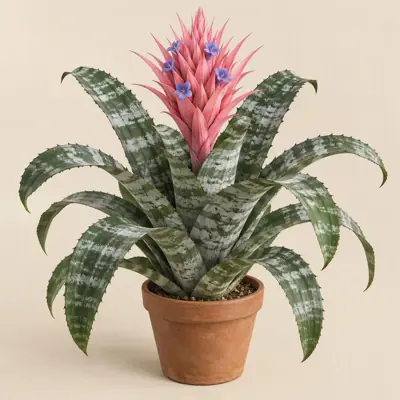
Overview
Aechmea fasciata is an evergreen perennial herb that typically grows as a rosette and can grow epiphytically on other plants. It is perennial; each mature rosette flowers once, after which the mother plant gradually dies while basal offsets may develop.
Origin and habitat
Aechmea fasciata is native to Brazil, with sources further identifying southern and southeastern Brazil, including Bahia and Rio de Janeiro states. It occurs in humid tropical regions and environments associated with Brazil's Atlantic coastal forests, often growing epiphytically in rainforest or on tall trees. Its climate is tropical, warm and humid.
Characteristics
Sources differ on mature size, giving about 30–90 cm in height and about 30–60 cm in spread. It is reported to grow slowly and has leathery, stiff leaves arranged in a tubular or funnel-shaped basal rosette; the leaves are dark green to silvery gray, with white water-absorbing scales often forming conspicuous transverse bands, usually spiny margins and a short spine at the tip. The dense, nearly pyramidal central inflorescence has conspicuous pink to pink-red bracts and smaller flowers that are usually blue to purple and may become dark red or pale purple as they age; silvery, dense trichomes are also reported. One source reports flowering or inflorescence development from spring into summer, and fruit is reported to sometimes form after flowering as globose fruit covered with white hairs.
Light
Provide bright indirect light to partial shade; indoors it can be placed near an east- or west-facing window while avoiding prolonged strong direct sunlight. One source reports a light level of about 8000–9000, so sources are few.
Watering
During the growing season, keep the medium slightly moist but well drained; fill the central tank with a small amount of water and refresh it regularly. Sources differ on winter practice: watering should be reduced, while some recommend emptying the central tank to reduce the risk of rot. One source reports watering about 7–7 days in summer, so sources are few.
Humidity and airflow
It is generally reported to prefer high humidity and need moderate airflow.
Temperature and dormancy
The ideal temperature is 15–25 °C. Sources differ on a reported minimum of about 10 °C, while another single source gives about 16 °C, so evidence for these minimums is limited. It is frost tender; keep above freezing.
Growing medium and mounting
Use a moist but well-drained medium such as orchid medium, bromeliad medium, sphagnum moss, coconut husk, or a loose, humus-rich medium; it can also be grown epiphytically. It can be mounted, grown in a basket or potted.
Feeding
Fertilizer can be applied regularly during the growing season; sources describe slow-release fertilizer from spring through autumn or diluted liquid fertilizer in summer applied to leaves and roots, with feeding reduced in winter.
Propagation
Propagate by separating and planting basal offsets from the mother plant after the offsets have developed sufficiently.
Common problems
Common pests include scale insects and mealybugs. Leaf spot may occur, although another source describes the plant as generally having few disease problems. Excessively wet medium can increase the risk of crown or root rot, water left unchanged in the central tank can become stagnant and harbor pests, and overly strong direct light can scorch the leaves. It is sensitive to frost and low temperatures, has weak cold tolerance, and is suited to frost-free conditions.
Identification
Aechmea fasciata can be recognized by its water-holding funnel-shaped rosette, transverse silvery-white bands formed by water-absorbing scales on the leaves, and, when flowering, persistent conspicuous pink bracts with small blue-purple flowers.
Photos


Sources
- Wikipedia (en): Aechmea fasciata — CC BY-SA 4.0 · link
- 維基百科:蜻蜓菠萝 — CC BY-SA 4.0 · link
- Wikipedia (ja): シマサンゴアナナス — CC BY-SA 4.0 · link
- Wikipedia (de): Lanzenrosette — CC BY-SA 4.0 · link
- Wikipedia (fr): Aechmea fasciata — CC BY-SA 4.0 · link
- Wikipedia (es): Aechmea fasciata — CC BY-SA 4.0 · link
- NC State Plant Toolbox: Aechmea fasciata — copyright (facts only) · link
- RHS Plants: Aechmea fasciata — © RHS, facts only · link
- NHK みんなの趣味の園芸 植物図鑑: Aechmea fasciata — © NHK出版, facts only · link
- Top Tropicals catalog: Aechmea fasciata — © Top Tropicals LLC (facts only) · link
- Aechmea Fasciata Care: How To Grow A Vase Or Urn Plant (joyusgarden.com) — facts only (§12) · link
- Aechmea - Urn Plants (ukhouseplants.com) — facts only (§12) · link
- Aechmea fasciata: Growing Guidelines - Bromeliad Plant Care (www.bromeliads.info) — facts only (§12) · link
- Unlock Stunning Blooms & Lush Foliage: The Easy Guide to Silver Vase Bromeliad C (www.houseplant411.com) — facts only (§12) · link