
Tree roofleek, Tree aeonium (Aeonium arboreum)
Aeonium arboreum is an evergreen succulent small shrub with leaf rosettes at the ends of its branches. It is perennial; an individual flowering rosette dies after flowering once, while the plant can continue growing from other side branches or basal shoots.
Overview
Aeonium arboreum is an evergreen succulent small shrub with leaf rosettes at the ends of its branches. It is perennial; an individual flowering rosette dies after flowering once, while the plant can continue growing from other side branches or basal shoots.
Origin and habitat
For this cultivated horticultural form, its own natural range is not given; most accounts place Aeonium arboreum in the Canary Islands, especially Gran Canaria, while sources differ over the taxonomic status of Moroccan populations. Sources differ in describing habitats that include weathered volcanic soils in full sun to slight shade, as well as cliffs, exposed rock, and coastal environments. It is suited to subtropical or Mediterranean-type climates with mild, relatively dry winters and grows during winter through the cooler season.
Characteristics
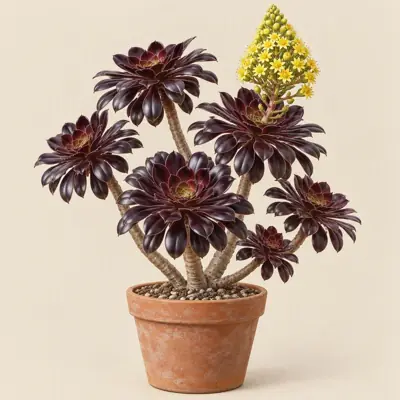
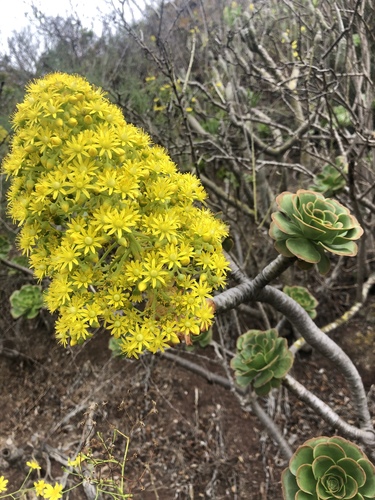
Sources differ on mature height, with a reported range of about 100–200 cm. A single source reports a mature spread of about 100–150 cm. Fleshy leaves form dense, flat to slightly concave rosettes at branch tips; 'Zwartkop' has dark black-purple to nearly black leaves, while the species generally has obovate to oblanceolate leaves with fine hairs along the margins. Mature rosettes can produce large panicle-like inflorescences from the center, bearing many small yellow to bright-yellow flowers; flowering time varies with the growing climate, and sources differ in describing a period spanning late winter through spring. Aeonium arboreum stores water in its leaves.
Light
Aeonium arboreum takes full sun and can also grow in bright conditions with slight shade; 'Zwartkop' needs ample bright light to develop its deep purple to nearly black leaf color.
Watering
Use a well-drained growing medium; during cool-season growth, water thoroughly after the surface dries, then greatly reduce watering during summer dormancy and avoid keeping the medium persistently wet.
Humidity and airflow
It is reported to need good airflow.
Temperature and dormancy
Sources differ on the lower temperature limit, with limited accounts indicating about -4 °C. A specialist-supported account gives a cold minimum of -4 °C, and the plant tolerates brief light frost. Sources differ in their hardiness-zone classifications. It is reported to rest in summer; in high temperatures it needs shade, and from the period after the rainy season into summer heat it should be kept in a shaded, well-ventilated location as it enters dormancy.
Growing medium and mounting
A well-drained loamy or sandy medium is suitable; containers can use a loam-based medium with added coarse material or a well-drained succulent medium. It needs a fast-draining mix.
Feeding
Feed lightly during active growth; the cited sources describe either balanced liquid fertilizer during the growing season or small amounts of slow-release fertilizer or liquid fertilizer during growth.
Propagation
Propagation can be by rosette or stem cuttings, seed, or division of clumping plants.
Common problems
Potential pests include aphids, scale insects, mealybugs, and root mealybugs. Sources generally describe no major disease problems. Persistently wet growing medium is unfavorable, watering should be reduced with summer dormancy during hot weather, and insufficient light makes it harder for 'Zwartkop' to maintain its vivid deep black-purple foliage. It is sensitive to severe cold and prolonged freezing, so protected cultivation is suitable in cold areas; during extreme heat, ventilation, shade, and reduced watering are appropriate.
Identification
Its most conspicuous features are large rosettes at branch tips and nearly black, deep-purple leaves; strong light can make the foliage appear closer to black, contributing to a tree-like succulent form.
Photos



Sources
- GBIF Backbone: Aeonium arboreum (L.) Webb & Berthel. — CC BY 4.0 · link
- Wikipedia (en): Aeonium arboreum — CC BY-SA 4.0 · link
- Wikipedia (de): Aeonium arboreum — CC BY-SA 4.0 · link
- Wikipedia (fr): Aeonium arboreum — CC BY-SA 4.0 · link
- Wikipedia (es): Aeonium arboreum — CC BY-SA 4.0 · link
- GBIF descriptions: Checklist of introduced taxa in Cyprus; DAISIE - Inventory of alien invasive species in Europe; Chap — per dataset · link
- Wikipedia (nl): Aeonium arboreum — CC BY-SA 4.0 · link
- LLIFLE Encyclopedia of living forms: Aeonium arboreum — CC BY-SA · link
- RHS Plants: Aeonium arboreum — © RHS, facts only · link
- Desert-Tropicals: Aeonium arboreum — © Philippe Faucon (desert-tropicals.com), facts only · link
- The Succulent Plant Page: Aeonium (genus-level) — © R.J. Hodgkiss, facts only · link
- NHK みんなの趣味の園芸 植物図鑑: Aeonium (genus-level) — © NHK出版, facts only · link
- NC State Plant Toolbox: Aeonium (genus-level) — copyright (facts only) · link
- Top Tropicals catalog: Aeonium arboreum — © Top Tropicals LLC (facts only) · link