
Fox tail agave (Agave attenuata)
Sources describe Agave attenuata somewhat differently, but it is a perennial evergreen succulent that forms leaf rosettes and, when mature, may develop a conspicuous, sometimes branching stem, giving it a clumping, shrub-like form. Sources differ on details of its life cycle; it is perennial and usually flowers once per mature rosette, which gradually dies after flowering, pollination, and seed formation, while basal offsets or plantlets on the inflorescence can continue growth.
Overview
Sources describe Agave attenuata somewhat differently, but it is a perennial evergreen succulent that forms leaf rosettes and, when mature, may develop a conspicuous, sometimes branching stem, giving it a clumping, shrub-like form. Sources differ on details of its life cycle; it is perennial and usually flowers once per mature rosette, which gradually dies after flowering, pollination, and seed formation, while basal offsets or plantlets on the inflorescence can continue growth.
Origin and habitat
Sources differ somewhat on its native range in Mexico, principally describing Jalisco, the State of Mexico, and intervening parts of central Mexico, with some also including Michoacán. In its native habitat it occurs on rocky upland slopes, ledges, and cliffs, with records also from rocky settings in pine forest; sources differ on the reported elevation range. It is suited to warm, sunny, well-drained conditions, tolerates drought, and is sensitive to frost.
Characteristics
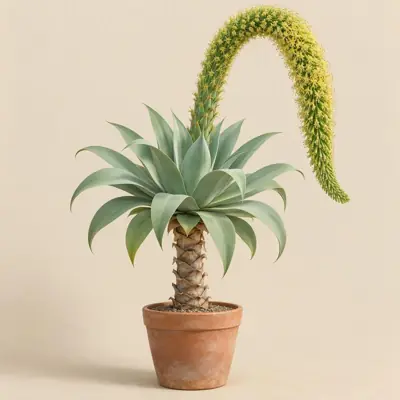
Mature plants reach 100–150 cm in height; reports of mature spread are few and give about 150–250 cm. It is generally reported to grow slowly, with growth mainly in spring and summer. Sources differ in describing the broad, fleshy, soft leaves, which range from ovate to tapering and from pale yellow-green or gray-green to blue-gray-green, sometimes with a powdery-looking surface; the margins are usually without toothed spines, and the soft tip wears away with age. Sources describe pale greenish-yellow to green-yellow flowers densely arranged on a long, stout inflorescence that often gradually curves downward into a foxtail- or swan-neck-like form; flowering is reported in spring, and after flowering seed pods and seeds can form while many plantlets may also develop in the flower axils, and Agave attenuata stores water in its leaves.
Light
Agave attenuata takes full sun and is suited mainly to full sun or bright conditions, while also adapting to partial sun or some shade; a sudden large increase in light may scorch the leaves.
Watering
It tolerates drought; during active growth it can receive more generous watering, but the growing medium should not remain excessively wet for long, while winter watering should be greatly reduced to keep conditions relatively dry. Winter watering is given at intervals of 15–30 days.
Temperature and dormancy
Sources differ on the lower temperature limit, placing it at about 0 °C, while the few available reports put an ideal range at about 10–13 °C. Sources also differ on the hardiness-zone description; it is frost tender and should be kept above freezing. It rests in winter and can tolerate high temperatures. A specialist account from the few available sources reports a cold minimum of about -2 °C.
Growing medium and mounting
It needs a fast-draining mix; well-drained loamy or sandy media are suitable, and it can tolerate relatively poor soil, although sources also indicate better performance in more fertile, well-drained media.
Feeding
Slow-release fertilizer can be used during active growth, with sources giving differing schedules for its application.
Propagation
Agave attenuata can be propagated from seed, basal suckers or offsets, and bulbils formed on the inflorescence.
Common problems
Possible pests include scale insects and snails, which may feed on the plant and cause cosmetic damage; general Agave cultivation information also lists thrips as a possible pest. Sources differ on disease occurrence: RHS describes the species as generally having few diseases, while general Agave cultivation information records black spot and rust as possibilities. Poor drainage, heavy rain, or standing water can cause rot, while a sudden increase in light intensity can scorch the leaves. It does not tolerate frost or freezing conditions, and low temperatures can cause severe damage; prolonged heavy rain and standing water should also be avoided.
Identification
Compared with most agaves, Agave attenuata has soft leaves that are usually spineless, and mature plants may show an exposed woody or gray stem. Its large, downward-curving inflorescence, resembling a foxtail or swan neck, is an important identifying feature.
Photos


Sources
- Wikipedia (en): Agave attenuata — CC BY-SA 4.0 · link
- 維基百科:翠綠龍舌蘭 — CC BY-SA 4.0 · link
- Wikipedia (de): Drachenbaum-Agave — CC BY-SA 4.0 · link
- Wikipedia (fr): Agave attenuata — CC BY-SA 4.0 · link
- Wikipedia (es): Agave attenuata — CC BY-SA 4.0 · link
- LLIFLE Encyclopedia of living forms: Agave attenuata — CC BY-SA · link
- RHS Plants: Agave attenuata — © RHS, facts only · link
- USDA PLANTS Database: Agave attenuata — Public domain (US Government work) · link
- NHK みんなの趣味の園芸 植物図鑑: Agave attenuata — © NHK出版, facts only · link
- Top Tropicals catalog: Agave attenuata — © Top Tropicals LLC (facts only) · link
- Agave attenuata Foxtail Agave | Mountain Crest Gardens™ (mountaincrestgardens.com) — facts only (§12) · link
- Agave attenuata | Giromagi cactus and succulents for sale | Buy plants online (www.giromagi.com) — facts only (§12) · link
- PUKUBOOK: Agave attenuata — CC BY-NC (facts only) · link