
Agave (Agave desmettiana)
Sources differ in their descriptions, but Agave is described as a perennial evergreen succulent that typically forms a basal rosette of leaves. Agave is perennial; most kinds are reported to have individual rosettes that flower only once and die after fruiting, while some can flower repeatedly.
Overview
Sources differ in their descriptions, but Agave is described as a perennial evergreen succulent that typically forms a basal rosette of leaves. Agave is perennial; most kinds are reported to have individual rosettes that flower only once and die after fruiting, while some can flower repeatedly.
Origin and habitat
Sources differ on the emphasis of its native range, describing dry regions of the Americas, including southern North America, Central America, the West Indies, and northern South America, with another account emphasizing Mexico and desert regions of the southwestern United States. Agave is reported to be native to dry, desert, or similarly water-limited habitats and adapted to hot, dry conditions with limited water; most kinds are drought tolerant.
Characteristics
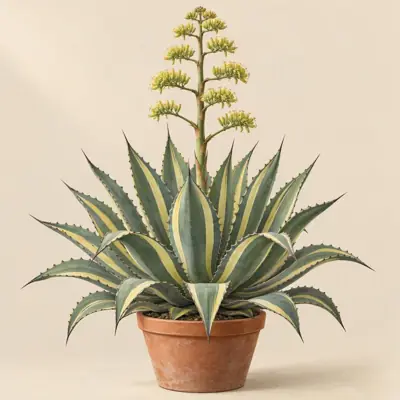
With few sources available, mature height is reported at about 5–200 cm and mature spread at about 0–457.2 cm. Most kinds are reported to grow very slowly. Sources differ in their descriptions of the leaves, which are arranged in rosettes and are thick and succulent, storing water in their leaves; most kinds have sharp marginal teeth and a pointed terminal spine, while variegated forms may have creamy-white or yellow marginal or central variegation. At maturity, Agave is reported to produce a tall flowering stalk from the center of the rosette with many short tubular flowers; some kinds also form bulbils on the inflorescence, and fruit can form after pollination and fertilization, after which most once-flowering rosettes die.
Light
Potted Agave is generally placed where it receives as much sunlight as possible and takes full sun.
Watering
From spring through autumn, watering is generally delayed until the potting medium has dried; in winter, water is reduced substantially. Prolonged wet soil and overwatering are generally avoided because they can increase the risk of rot.
Temperature and dormancy
Sources differ on the reported USDA hardiness of some variegated forms of Agave americana. Agave is generally described as frost hardy and as resting in winter.
Growing medium and mounting
Agave generally needs a fast-draining mix; one source describes a well-drained medium, while another recommends very well-drained sandy soil.
Feeding
During the spring-to-autumn growing period, slow-release fertilizer or fast-acting liquid fertilizer is reported to be suitable.
Propagation
Agave is reported to be propagated by dividing basal offsets, and some kinds can also be propagated from rhizomes, seeds, or bulbils from the inflorescence; roots should be retained when offsets are separated.
Common problems
Agave is reported to be susceptible to scale insects, thrips, mealybugs, agave weevils, and agave mites. Black spot and rust are reported problems, while overly wet soil, poor drainage, or excessive watering can lead to root rot or other rot. Scale insects are reported to occur throughout the year, while thrips are more likely during hot summer conditions. Sources differ on weather sensitivity: many kinds tolerate low temperatures and some can overwinter outdoors, while some are frost-sensitive, and certain cold-hardy kinds can still be vulnerable to rot from excessive winter rain.
Identification
Agave is generally identified by thick, succulent leaves arranged in a rosette; most kinds have marginal spines and a sharp terminal spine, and flowering plants produce a very tall stalk from the center of the rosette.