
Agave isthmensis (Agave isthmensis)
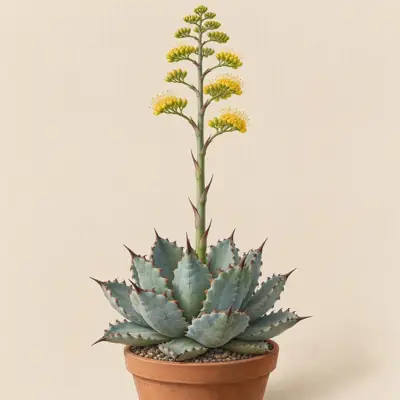
Agave isthmensis is a small succulent that forms tight rosettes and often develops clumps through underground stems or offsets. It is monocarpic: an individual rosette ends its life cycle after flowering, while the plant can continue producing offsets.
Overview
Agave isthmensis is a small succulent that forms tight rosettes and often develops clumps through underground stems or offsets. It is monocarpic: an individual rosette ends its life cycle after flowering, while the plant can continue producing offsets.
Origin and habitat
Agave isthmensis is native to the Isthmus of Tehuantepec region of southern Mexico, in Oaxaca and Chiapas. It occurs from low elevations into higher sites, including woodland, hillsides, and habitats among grasses and boulders; described populations occur on coastal hillsides and inland east-facing slopes. Its native habitat is reported to include hot, strongly sunlit environments from low-elevation coastal areas to inland slopes in southern Mexico.
Characteristics
Sources differ on mature size, placing height at about 17–32 cm and spread at about 25–36 cm. The densely packed rosette has powdery gray-blue to icy blue, obovate to spoon-shaped, slightly concave leaves that narrow at the base and are broadest near the tip; the margins are shallowly scalloped with rigid dark reddish-brown to black teeth, the tip bears a dark brown to black spine, and conspicuous bud imprints are often present. The fleshy yellow flowers, sometimes tinged rusty red, are borne on short lateral branches in the upper part of an upright panicle; flowering occurs from summer to late summer, and the fruit is an ovoid, chambered capsule containing flat black seeds. A single source does not provide a specific growth rate for this species but reports that most Agave species grow very slowly; Agave isthmensis also stores water in its leaves.
Light
Agave isthmensis takes full sun, with full sun suitable in coastal environments and filtered light to partial sun preferred in hotter inland conditions; potted plants can scorch if moved suddenly from low light into intense sun.
Watering
This is a water-efficient succulent; in cultivation it should be grown in a well-drained medium and problems from an excessively wet medium should be avoided.
Temperature and dormancy
The limited sources place its minimum at about -3 °C and generally report that it tolerates brief light frost. A single source reports that it rests in winter. In inland areas, midday sun is reported to be very intense, and potted plants exposed suddenly can scorch and develop necrotic patches.
Growing medium and mounting
Agave isthmensis needs a fast-draining, well-drained soil or growing medium.
Feeding
A single source for the genus Agave recommends slow-release fertilizer or fast-acting liquid fertilizer during the growing period from spring through autumn.
Propagation
Agave isthmensis can be propagated by separating and planting offsets or suckers, or from seed.
Common problems
Sources on Agave cultivation report possible problems from scale insects, mealybugs, thrips, agave snout weevils, and agave mites, as well as black spot, rust, and root rot associated with an overly wet medium or excessive watering. Potted plants can develop sun scorch and necrotic patches after sudden exposure to intense sunlight, while poor drainage and overwatering can increase the risk of root rot. It is reported to have limited cold tolerance and to withstand light frost; a specialist source recommends protective covering when frost is expected.
Identification
Agave isthmensis is compact and low-growing, with broad, short, powdery blue spoon-shaped leaves, large dark marginal teeth, and black-brown terminal spines; it resembles Agave potatorum but is usually smaller in plant and flower size, with shorter leaves and deeper notches between the leaf teeth.
Photos


Sources
- Wikipedia (en, genus): Agave — CC BY-SA 4.0 · link
- Wikipedia (de): Agave isthmensis — CC BY-SA 4.0 · link
- LLIFLE Encyclopedia of living forms: Agave isthmensis — CC BY-SA · link
- NHK みんなの趣味の園芸 植物図鑑: Agave (genus-level) — © NHK出版, facts only · link
- NC State Plant Toolbox: Agave (genus-level) — copyright (facts only) · link
- Agave isthmensis | Giromagi cactus and succulents | Buy plants online (www.giromagi.com) — facts only (§12) · link
- PUKUBOOK: Agave isthmensis — CC BY-NC (facts only) · link