
Thorn-crested Agave (Agave lophantha)
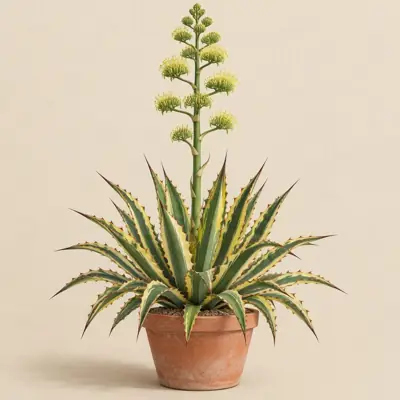
Agave lophantha is an evergreen succulent with no stem or only a very short stem, growing as rosettes and usually producing lateral shoots that form clumps. It is perennial; an individual rosette is usually monocarpic, with the central rosette dying after flowering while new rosettes formed from lateral shoots can continue growing.
Overview
Agave lophantha is an evergreen succulent with no stem or only a very short stem, growing as rosettes and usually producing lateral shoots that form clumps. It is perennial; an individual rosette is usually monocarpic, with the central rosette dying after flowering while new rosettes formed from lateral shoots can continue growing.
Origin and habitat
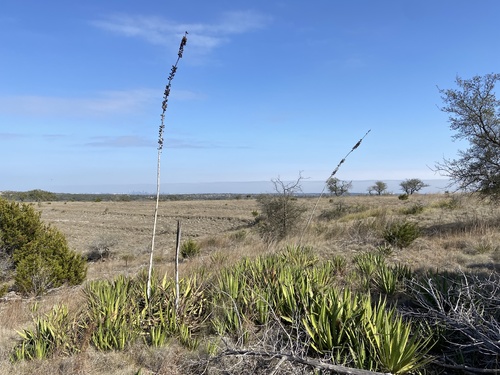
Sources differ on the precise native range, describing southern North America from southern Texas in the United States into eastern Mexico, including Coahuila, Nuevo León, Tamaulipas, San Luis Potosí, Veracruz, and Puebla. Natural habitats include well-drained limestone ground, sandy flats, cliffs and rocky outcrops, as well as open woodland and oak woodland with sufficient light. Sources differ in their descriptions, but the species is adapted to sunny, dry to semi-dry, well-drained environments, has good drought tolerance, and can withstand limited cold.
Characteristics
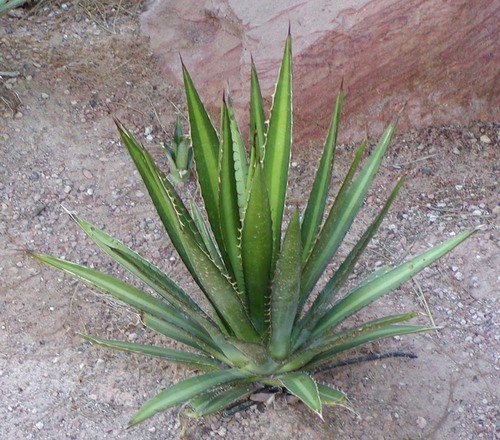
Sources differ on mature height, with the few available accounts placing it at about 30–60 cm, while mature spread is 50–100 cm. It stores water in its leaves; the leaves are linear to lance-shaped, relatively stiff, pale green to yellow-green, with conspicuously wavy to rounded-toothed margins bearing sharp teeth, a sharp terminal spine, and in some plants a pale central longitudinal stripe. It is reported to grow quite quickly in summer when supplied with more water, and mature plants produce a tall flower stalk bearing pale greenish-yellow to yellow-green flowers concentrated mainly toward the upper part of the inflorescence, with flowering reported in spring. The fruit is reported to be a capsule, stalkless or short-stalked, either elongated-ellipsoid or nearly spherical, with a beak-like projection at the tip.
Light
It takes full sun and can also grow in bright partial sun; sources differ somewhat, with moderate shade also described as suitable during hot summers.
Watering
During the growing season it can be watered more generously, but the growing medium should dry thoroughly between waterings; in winter, water should be greatly reduced and supplied only enough to prevent the leaves from shriveling from excessive dryness. Winter watering is given at intervals of 15–30 days.
Temperature and dormancy
Agave lophantha is frost hardy, rests in winter, and has a stated cold minimum of -5 °C. It is reported to benefit from some shade in summer, although outdoor-grown plants can tolerate some heat and full sun.
Growing medium and mounting
The growing medium must be well drained and can be a cactus or succulent mix, sandy soil, or loam; wild populations are often found on limestone, and some sources indicate a preference for neutral to alkaline conditions among plants associated with limestone environments. It needs a very fast-draining mix.
Feeding
Diluted liquid fertilizer can be applied during the growing season, and more fertilizer and water promote faster growth.
Propagation
It can be propagated by seed or by separating basal lateral shoots; the shoots can be removed and planted during a suitable season, with the cut allowed to dry before planting in the growing medium.
Common problems
Scale insects may occur; general information for Agave also lists mealybugs, agave weevils, and agave mites as pests. Species-specific information describes disease as generally uncommon, while general cultivation information for Agave records root rot under overly wet conditions as well as black spot and rust. An overly wet growing medium or excessive watering can lead to root rot, and the rigid marginal teeth and terminal spine can cause puncture injuries. It tolerates drought and some heat and has limited frost tolerance, but is better kept away from prolonged freezing conditions; good drainage and drier conditions are especially important in cold weather.
Identification
It can be distinguished by its orderly rosettes, conspicuously wavy leaf margins densely armed with sharp teeth, sharp terminal spines, and, in some forms, a pale central longitudinal stripe; it readily produces basal lateral shoots that form dense clumps.
Photos


Sources
- Wikipedia (en): Agave univittata — CC BY-SA 4.0 · link
- Wikipedia (en): Agave lophantha — CC BY-SA 4.0 · link
- LLIFLE Encyclopedia of living forms: Agave lophantha — CC BY-SA · link
- Useful Tropical/Temperate Plants: Agave lophantha — CC BY-NC-SA 3.0 (facts only) · link
- RHS Plants: Agave lophantha — © RHS, facts only · link
- USDA PLANTS Database: Agave lophantha — Public domain (US Government work) · link
- NHK みんなの趣味の園芸 植物図鑑: Agave (genus-level) — © NHK出版, facts only · link
- NC State Plant Toolbox: Agave (genus-level) — copyright (facts only) · link
- PUKUBOOK: Agave lophantha — CC BY-NC (facts only) · link