
Parry's agave (Agave parryi)
Agave parryi is an evergreen, perennial succulent that usually lacks an obvious stem, forms a tight rosette, and can form colonies through rhizomes or offsets. It is a perennial that flowers and fruits once; a mature rosette dies after flowering and fruiting, but is usually succeeded by new plants arising from offsets or rhizomes.
Overview
Agave parryi is an evergreen, perennial succulent that usually lacks an obvious stem, forms a tight rosette, and can form colonies through rhizomes or offsets. It is a perennial that flowers and fruits once; a mature rosette dies after flowering and fruiting, but is usually succeeded by new plants arising from offsets or rhizomes.
Origin and habitat
Sources differ on its native range, describing southwestern North America, mainly Arizona, New Mexico, and Texas in the United States and northern and western Mexico; Chihuahua and Durango are explicitly included, while some sources also list Sonora. It grows mainly on dry, gravelly or rocky slopes and also occurs in grassland, desert scrub, shrubland, open oak woodland, pine-oak woodland, and other open woodland. Its native environment is dry and can be quite cold, with winter temperatures below freezing and snow in some habitats; the plant is drought tolerant and strongly cold tolerant.
Characteristics
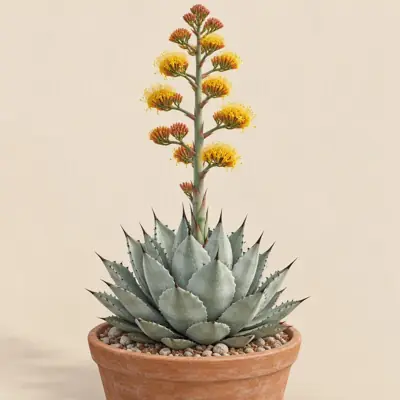
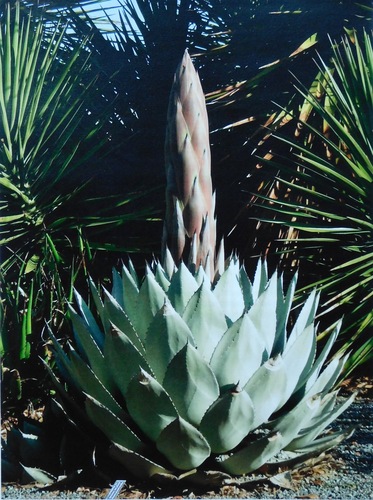
Sources differ on mature height, placing it at about 15–75 cm, while mature spread is 25–100 cm; growth is slow. The thick, rigid leaves are tightly arranged in a rosette, range from pale green and gray-green to glaucous gray-blue, and may be linear, lance-shaped, ovate, or spoon-shaped; the margins may have teeth or short spines, the tip bears a rigid brown, gray-brown, or black terminal spine darker than the leaf, and the surface may retain impressions from earlier leaves. At maturity it produces a large, branched inflorescence with bright yellow to yellow-orange flowers and buds that may be red or pink; flowering occurs in summer. The fruit is reported to be an ovoid to oblong, three-chambered capsule with black, irregularly shaped seeds, and Agave parryi stores water in its leaves.
Light
Agave parryi takes full sun.
Watering
It is highly drought tolerant; the growing medium should dry thoroughly between waterings, and watering should be reduced in winter while conditions are kept relatively dry. Sources differ on winter watering intervals, suggesting about 30–60 days.
Temperature and dormancy
It is frost hardy and has a cold minimum of -18 °C. Sources differ on another stated minimum, with limited sources indicating about -21 °C. Sources differ on a reported RHS hardiness classification, while a single source reports that Agave parryi rests in winter. Sources describe it as tolerant of summer heat or heat, but do not describe a specific stress response to high temperatures.
Growing medium and mounting
Use a well-drained sandy or rocky growing medium; RHS recommends cactus growing medium and also indicates sandy soil as suitable. Agave parryi needs a very fast-draining mix.
Feeding
RHS is reported to recommend applying a low-nitrogen fertilizer during summer.
Propagation
Agave parryi can be propagated from seed, by removing offsets, by division, or from young plants produced by rhizomes.
Common problems
Scale insects are reported as a possible pest. Excess moisture is a major cultivation risk, and sources differ on reports that overly wet growing medium can lead to root rot. The leaf tips and margins bear sharp, rigid spines, so placement and handling should avoid injury. It tolerates drought, heat, and low temperatures, but strong cold tolerance depends on how dry the conditions are; some sources explicitly report tolerance of lower temperatures under dry conditions.
Identification
Agave parryi can be recognized by its tight, often artichoke-like rosette, gray-green to gray-blue leaves with conspicuous impressions from older leaves, and contrasting dark, rigid terminal spines.
Photos



Sources
- Wikipedia (en): Agave parryi — CC BY-SA 4.0 · link
- Wikipedia (de): Agave parryi — CC BY-SA 4.0 · link
- Wikipedia (fr): Agave parryi — CC BY-SA 4.0 · link
- Wikipedia (es): Agave parryi — CC BY-SA 4.0 · link
- NC State Plant Toolbox: Agave parryi — copyright (facts only) · link
- LLIFLE Encyclopedia of living forms: Agave parryi — CC BY-SA · link
- Useful Tropical/Temperate Plants: Agave parryi — CC BY-NC-SA 3.0 (facts only) · link
- RHS Plants: Agave parryi — © RHS, facts only · link
- USDA PLANTS Database: Agave parryi — Public domain (US Government work) · link
- NHK みんなの趣味の園芸 植物図鑑: Agave (genus-level) — © NHK出版, facts only · link
- Agave parryi | Giromagi cactus and succulents for sale | Buy plants online (www.giromagi.com) — facts only (§12) · link
- PUKUBOOK: Agave parryi — CC BY-NC (facts only) · link