
Queen Victoria Agave (Agave victoriae-reginae)
Agave victoriae-reginae is an evergreen perennial succulent that usually forms a compact stemless or nearly stemless rosette; it may grow singly, while some plants produce lateral offsets and form multiple heads. Each rosette typically flowers once in its lifetime and dies after flowering and fruiting, while basal offsets, when present, can continue growing.
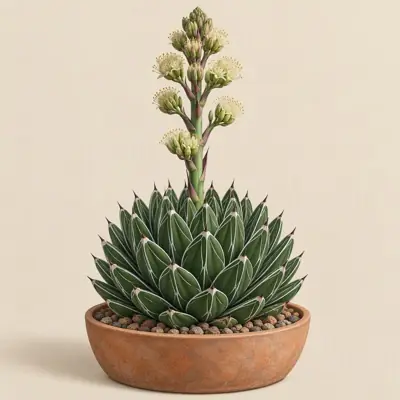
Overview
Agave victoriae-reginae is an evergreen perennial succulent that usually forms a compact stemless or nearly stemless rosette; it may grow singly, while some plants produce lateral offsets and form multiple heads. Each rosette typically flowers once in its lifetime and dies after flowering and fruiting, while basal offsets, when present, can continue growing.
Origin and habitat
Sources differ on its native range, describing it as occurring from northern to northeastern Mexico, mainly around the Chihuahuan Desert and Sierra Madre Oriental, including Coahuila, Nuevo León, and Durango. It occurs in arid to semi-arid environments, mainly on calcareous substrates, including rocky and steep slopes, canyon cliffs, xeric scrub, and montane scrub. It is adapted to dry to semi-dry conditions, is drought tolerant, and has relatively good cold tolerance among agaves; keeping it dry in cold conditions is considered beneficial.
Characteristics
Sources differ on mature size, giving a height of about 10–65 cm and a spread of about 10–70 cm. Growth is very slow, and the plant stores water in its leaves. The short, thick, rigid leaves are green to dark green, commonly linear, ovate, or lance-shaped and tightly arranged, with conspicuous white markings on the leaf surfaces and margins; the margins are usually toothless and the tips bear hard black or dark spines. Mature plants produce a tall, upright spike-like or narrow racemose inflorescence with densely borne flowers; sources differ in describing the flowers as creamy white, pale green, or tinged with red or purplish red, and flowering occurs in summer.
Light
It takes full sun to bright, light shade; indoors, direct sunlight or a very bright position is suitable.
Watering
Use a well-drained medium and allow the soil to dry after watering before watering again; provide normal watering during summer growth and keep it almost dry in winter.
Humidity and airflow
It is reported to need good airflow.
Temperature and dormancy
A single source reports a minimum of about -5 °C, while another specialist source gives a cold minimum of about -10 °C; sources are few. It is reported to be frost hardy and rests in winter. A specialist source reports that intense sunlight during the hottest summer months may cause sunburn and recommends afternoon shade.
Growing medium and mounting
It needs a fast-draining, porous medium; sandy soil, loam, or standard cactus mix can be used, while in its native habitat it commonly occurs on calcareous soils and rocky substrates.
Feeding
Sources differ on feeding, but describe applying a balanced liquid fertilizer during the growing season.
Propagation
It can be propagated from seed, and some plants also form basal offsets, although the extent of offset production varies greatly among individuals or forms.
Common problems
Scale insects and mealybugs may affect the plant. RHS is reported to describe it as generally having few diseases. Unsuitable light, watering, or soil fertility conditions are reported to cause the rosette to become distorted and lose its regular appearance. It has some cold tolerance, but winter cultivation guidance recommends keeping it dry and providing cold protection; UK cultivation information recommends a protected greenhouse or similar environment in winter.
Identification
Agave victoriae-reginae has a compact, strongly geometric rosette of thick, rigid green leaves with conspicuous white longitudinal, marginal, or ridge markings; the leaf margins are usually toothless and the tips bear hard spines.
Photos


Sources
- Wikipedia (en): Agave victoriae-reginae — CC BY-SA 4.0 · link
- 維基百科:厚葉龍舌蘭 — CC BY-SA 4.0 · link
- Wikipedia (ja): ササノユキ — CC BY-SA 4.0 · link
- Wikipedia (de): Agave victoriae-reginae — CC BY-SA 4.0 · link
- Wikipedia (fr): Agave victoriae-reginae — CC BY-SA 4.0 · link
- Wikipedia (es): Agave victoriae-reginae — CC BY-SA 4.0 · link
- LLIFLE Encyclopedia of living forms: Agave victoriae-reginae — CC BY-SA · link
- Useful Tropical/Temperate Plants: Agave victoriae-reginae — CC BY-NC-SA 3.0 (facts only) · link
- RHS Plants: Agave victoriae-reginae — © RHS, facts only · link
- NHK みんなの趣味の園芸 植物図鑑: Agave (genus-level) — © NHK出版, facts only · link
- NC State Plant Toolbox: Agave (genus-level) — copyright (facts only) · link
- Agave victoriae-reginae | Giromagi cactus and succulents for sale | Buy plants o (www.giromagi.com) — facts only (§12) · link