
Philippine evergreen (Aglaonema commutatum)
Aglaonema commutatum is a perennial herbaceous foliage plant with an upright to clumping habit and is commonly grown indoors in pots.
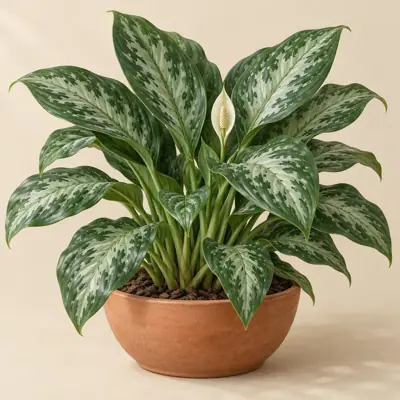
Overview
Aglaonema commutatum is a perennial herbaceous foliage plant with an upright to clumping habit and is commonly grown indoors in pots.
Origin and habitat
Sources differ on its native range, which is described as the Philippines and northeastern Sulawesi. The genus Aglaonema is reported to be native to humid, deeply shaded tropical forest environments. It is tropical to subtropical, preferring warm conditions and not tolerating low temperatures well.
Characteristics
Sources differ, with the few available sources placing mature height at about 60.96–152.4 cm. The leaves are green with pale or silvery markings along the lateral veins; cultivated plants may have elliptic to oblong leaves marked in shades of green, white, yellow, or silver. The inflorescence is typical of the arum family, with a white to greenish-white spathe; genus-level information describes the individual flowers as small. Flowering occurs in summer, around early summer according to species information, though flowering is usually uncommon indoors; red, berry-like fruits may form in clusters.
Light
It suits bright, indirect light to partial sun and tolerates low light; strong direct sunlight should be avoided because it can yellow or scorch the leaves.
Watering
During active growth, water when the surface of the growing medium begins to dry, keeping it moderately moist without prolonged excess moisture; reduce watering in winter.
Humidity and airflow
It is generally reported to prefer high humidity.
Temperature and dormancy
A single source places it in a warm hardiness range and reports a lower temperature of about 15 °C; available sources are few. It is generally considered frost tender; keep above freezing.
Growing medium and mounting
Use a humus-rich, well-drained growing medium; well-drained potting mix is suitable for containers. It has soil roots and generally uses a standard mix.
Feeding
Fertilize regularly during active growth; source approaches include applying a long-lasting complete fertilizer seasonally or a slow-release fertilizer periodically from spring through autumn.
Propagation
It can be propagated by division, stem cuttings, or seed; in cultivation, basal clumps can be divided or stem sections can be cut for propagation.
Common problems
Potential pests include scale insects, spider mites, aphids, and mealybugs. Possible disease problems include damping-off, soft rot, and root rot associated with overwatering. Strong sunlight can yellow or scorch leaves, overwatering can cause root rot, dry air or cold drafts can cause leaf browning, and low temperatures can cause chilling injury. It is cold-sensitive and susceptible to frost, and the genus Aglaonema may develop chilling injury after exposure to low temperatures.
Identification
Distinctive features include conspicuously variegated leaves and fleshy stems that become jointed or cane-like with age; genus-level identification also includes several prominent lateral veins on each leaf.
Photos


Sources
- GBIF Backbone: Aglaonema commutatum Schott — CC BY 4.0 · link
- Wikipedia (en): Aglaonema commutatum — CC BY-SA 4.0 · link
- Wikipedia (es): Aglaonema commutatum — CC BY-SA 4.0 · link
- 農業知識入口網 植物圖鑑: Aglaonema commutatum — © MOA, facts only · link
- USDA PLANTS Database: Aglaonema commutatum — Public domain (US Government work) · link
- NHK みんなの趣味の園芸 植物図鑑: Aglaonema commutatum — © NHK出版, facts only · link
- NC State Plant Toolbox: Aglaonema (genus-level) — copyright (facts only) · link
- Top Tropicals catalog: Aglaonema commutatum — © Top Tropicals LLC (facts only) · link
- UF/IFAS EDIS: Chilling Injury in Tropical Foliage Plants: II. Aglaonema — © University of Florida (facts only) · link
- Aglaonema commutatum | Foliage Factory (foliage-factory.com) — facts only (§12) · link