
Philippine evergreen (Aglaonema commutatum)
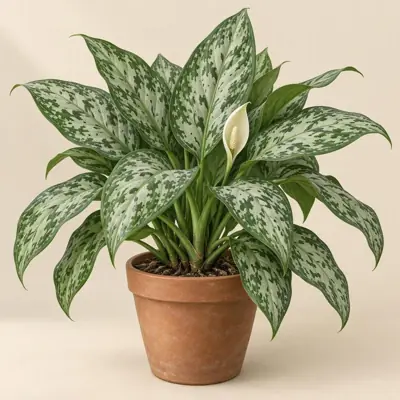
Aglaonema commutatum is a clumping, upright, herbaceous foliage plant and a perennial; 'Silver Queen' has an upright habit.
Overview
Aglaonema commutatum is a clumping, upright, herbaceous foliage plant and a perennial; 'Silver Queen' has an upright habit.
Origin and habitat
Sources differ on its native range, describing it as native to the Philippines and northeastern Sulawesi or, more broadly, to Southeast Asia. It is a tropical to subtropical plant that prefers warmth, tolerates heat, and does not tolerate low temperatures.
Characteristics
Sources differ on mature height, giving a range of about 20–60 cm. The leaves range from narrow and elongated to elliptical; 'Silver Queen' has green leaves with extensive silver-green markings, including silvery-gray bands generally following the lateral veins, while green remains along the margins, near the midrib, and between paler areas. It has the typical aroid inflorescence, with a white spadix and a white to greenish-white spathe; flowering begins around early summer, though plants grown indoors do not flower often. Clusters of red berries may form after flowering.
Light
It suits bright indirect light, bright shade, or partial sun, tolerates low light, and should be protected from strong direct sunlight, which can cause yellowing or scorching of the leaves.
Watering
During the growing season, water after the surface of the growing medium begins to dry, and reduce watering amount or frequency in winter; avoid prolonged wetness because overwatering can cause root rot.
Humidity and airflow
It is generally reported to prefer high humidity.
Temperature and dormancy
It is reported to be frost tender and should be kept above freezing. A single source reports a lower temperature of about 15 °C, so sources are few. A single source also reports a USDA hardiness zone, without a confirmed numerical range here.
Growing medium and mounting
Use a humus-rich, well-drained growing medium; a standard mix is suitable.
Feeding
Slow-release fertilizer can be used during the growing season; sources also describe using fast-acting liquid fertilizer or a long-lasting complete fertilizer on differing schedules.
Propagation
It can be propagated by division, stem cuttings, or seed, with division and cuttings described as more practical in cultivation; cuttings are reported to root under appropriate management.
Common problems
Reported pests include scale insects, spider mites, aphids, and mealybugs. Reported problems include damping-off, soft rot, and root rot. Strong sunlight can yellow or scorch leaves, overwatering can cause root rot, and very dry air or exposure to drafts can cause leaf browning. It is sensitive to low temperatures and frost and should be protected from freezing conditions, while being relatively heat tolerant.
Identification
'Silver Queen' is distinguished by extensive silver-green to silvery-gray bands on green leaves, generally arranged along the lateral veins to create prominent linear silver-green markings, together with a clumping habit.
Photos


Sources
- Wikipedia (en): Aglaonema commutatum — CC BY-SA 4.0 · link
- Wikipedia (es): Aglaonema commutatum — CC BY-SA 4.0 · link
- GBIF descriptions: Lista de especies de plantas exóticas y trasplantadas de Colombia; Catálogo de Plantas y Líquenes de — per dataset · link
- 農業知識入口網 植物圖鑑: Aglaonema commutatum — © MOA, facts only · link
- USDA PLANTS Database: Aglaonema commutatum — Public domain (US Government work) · link
- NHK みんなの趣味の園芸 植物図鑑: Aglaonema commutatum — © NHK出版, facts only · link
- NC State Plant Toolbox: Aglaonema (genus-level) — copyright (facts only) · link
- Top Tropicals catalog: Aglaonema commutatum — © Top Tropicals LLC (facts only) · link
- Aglaonema 'Silver Queen' | Foliage Factory (foliage-factory.com) — facts only (§12) · link
- Aglaonema 'Silver Queen' | Foliage Factory — facts only (§12) · link
- USPP10269P - Aglaonema plant named `Patricia` - Google Patents — facts only (§12) · link