
golden trumpet (Allamanda cathartica)
Allamanda cathartica is a perennial evergreen plant that may grow as a woody climbing shrub or vine, with stems that can trail, hang, or grow along supports; pruning can maintain a shrubby form, although sources describe its habit differently.
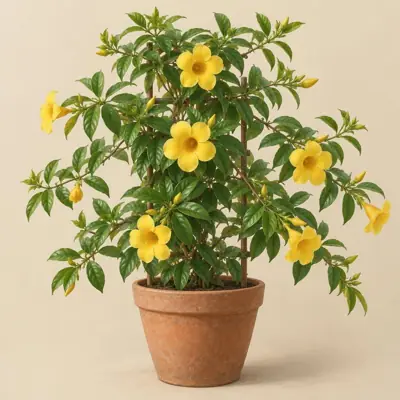
Overview
Allamanda cathartica is a perennial evergreen plant that may grow as a woody climbing shrub or vine, with stems that can trail, hang, or grow along supports; pruning can maintain a shrubby form, although sources describe its habit differently.
Origin and habitat
Allamanda cathartica is native to tropical America, centered on northern to eastern South America, with Brazil, Bolivia, French Guiana, Guyana, Suriname, and Venezuela explicitly included; sources differ on whether its native range also extends into Central America. It occurs along tropical rainforest riverbanks, in moist lowlands and coastal wetlands, and may also escape from cultivation into wasteland or abandoned farmland. It favors warm to hot, humid, frost-free tropical or subtropical conditions and is widely cultivated in tropical regions worldwide.
Characteristics
Sources differ on mature height, placing it at about 200–600 cm, while the few sources available report a mature spread of about 250–400 cm. Growth is fast and vigorous, with stems extending rapidly under suitable tropical or hot, humid conditions. The simple leaves are usually whorled, ranging from elliptic and lanceolate to obovate, with entire margins and often a glossy upper surface; the large flowers are bright yellow to golden yellow and funnel- or trumpet-shaped, with a lobed corolla, and may occur in terminal or axillary inflorescences. Sources differ on flowering season, with Taiwanese information describing flowering across spring, summer, and autumn; the fruit is a usually spherical to somewhat flattened ellipsoid, spiny capsule containing flat, winged seeds, although fruiting may be less common in cultivated plants.
Light
Bright conditions with full sun are preferred; excessive shade can reduce flowering and make the foliage and branches sparse, although sources differ and some indicate that light shade is tolerated.
Watering
During active growth it needs ample water, with soil kept slightly moist but well drained; watering should be reduced in winter or during dormancy, while prolonged waterlogging should be avoided.
Temperature and dormancy
Sources differ, but the limited information available places a minimum temperature at about 10 °C.
Growing medium and mounting
Fertile, organic-rich, well-drained soil is suitable, including sandy loam, leaf-mold-rich soil, or loam; acidic to neutral conditions are preferred, while strongly alkaline conditions may cause yellowing.
Feeding
It is reported that well-decomposed organic fertilizer can be used, and Taiwanese information recommends feeding in conjunction with winter pruning to encourage flowering the following year.
Propagation
Propagation is mainly by cuttings, with Taiwanese information recommending taking stem cuttings in spring or autumn and retaining multiple nodes on each cutting; seed propagation is also reported.
Common problems
In greenhouse cultivation, spider mites and greenhouse whiteflies are reported as possible pests, while diseases are generally reported to be uncommon. Excessive shade may result in poor flowering and sparse growth, strongly alkaline soil may cause leaf yellowing, and low temperatures may cause leaf drop or cold injury. It does not tolerate frost or low temperatures and is suited to frost-free conditions; reports indicate that sufficiently cold conditions can kill the plant and that warmer conditions are recommended for overwintering.
Identification
Allamanda cathartica can be recognized by its soft, trailing stems, whorled glossy leaves, large bright yellow funnel-shaped lobed flowers, and white milky sap.
Photos


Sources
- Wikipedia (en): Allamanda cathartica — CC BY-SA 4.0 · link
- 維基百科:軟枝黃蟬 — CC BY-SA 4.0 · link
- Wikipedia (ja): アリアケカズラ — CC BY-SA 4.0 · link
- Wikipedia (de): Goldtrompete — CC BY-SA 4.0 · link
- Wikipedia (fr): Allamanda cathartica — CC BY-SA 4.0 · link
- Wikipedia (es): Allamanda cathartica — CC BY-SA 4.0 · link
- GBIF descriptions: The checklist of alien seed plants of D.R. Congo, based on evidence from herbarium collections; Catá — per dataset · link
- NC State Plant Toolbox: Allamanda cathartica — copyright (facts only) · link
- TaiCOL 臺灣物種名錄: Allamanda cathartica — CC BY 4.0 · link
- 農業知識入口網 植物圖鑑: Allamanda cathartica — © MOA, facts only · link
- Useful Tropical/Temperate Plants: Allamanda cathartica — CC BY-NC-SA 3.0 (facts only) · link
- RHS Plants: Allamanda cathartica — © RHS, facts only · link
- USDA PLANTS Database: Allamanda cathartica — Public domain (US Government work) · link