
Giant Allium (Allium giganteum)
Allium giganteum is a bulbous perennial herbaceous plant.
Overview
Allium giganteum is a bulbous perennial herbaceous plant.
Origin and habitat
Sources differ on its native range: it extends from central to southwestern Asia, with Afghanistan, Iran, Turkmenistan, Tajikistan and Uzbekistan explicitly included by multiple sources; some also include Turkey, while others give different boundaries within Asia. Natural habitats include loose-textured slopes in low mountain areas, as well as forests, naturalized areas and disturbed sites. It is adapted to dry to semi-arid conditions and winters below freezing; it needs moisture during the growing season but prefers drier conditions during dormancy.
Characteristics
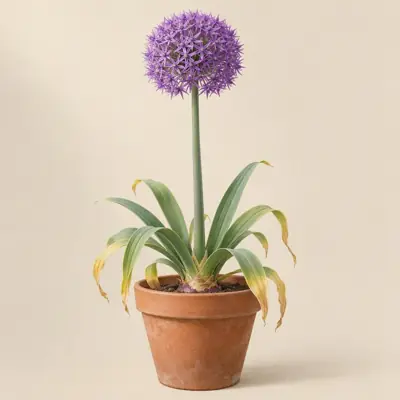
Sources differ on mature height, placing it at about 80–200 cm, while mature spread is 10–60 cm. The basal leaves are gray-green to pale green and broadly linear or strap-shaped, with an onion-like smell; they gradually yellow and dry around the onset of flowering. Dense, spherical umbels of purple, violet or pale purplish-pink flowers form atop tall, leafless flower stalks; sources differ in their descriptions of the floral details. Flowering is mainly in summer, commonly from early to midsummer, though some sources describe it as beginning in late spring; ornamental fruiting umbels are reported to form after flowering.
Light
It grows in full sun and can also adapt to bright, light shade provided by sparse shrubs in hot, dry conditions.
Watering
Keep it moderately moist during the growing season in well-drained conditions; mature plants tolerate summer drought, while dormancy should be drier and prolonged excess moisture or waterlogging can cause problems.
Temperature and dormancy
A single source reports a minimum temperature of about -5 °C, so sources are few for this figure. USDA and RHS hardiness classifications are reported for Allium giganteum.
Growing medium and mounting
It suits fertile or improved, well-drained soil, including loam, sand or chalk, and can grow in acidic, neutral or alkaline soil; avoid waterlogging.
Propagation
It is reported to be propagated by dividing bulbs or from seed.
Common problems
Bulb mites are reported as a possible pest. Excessively wet conditions are reported to favor fungal problems, including black rot of leaves and bulbs and bulb rot. Poor drainage and excessive moisture can cause bulb rot, and tall flower stalks sometimes need support. It does not tolerate prolonged cold, wet conditions or persistent rain during dormancy; even with good drainage, cool and wet climates can increase the risk of bulb rot.
Identification
Allium giganteum is a large ornamental allium with tall, bare flower stalks rising from bulbs and topped by conspicuous, dense, spherical purple to pale purplish-pink flower clusters; its basal leaves begin to decline during flowering.
Photos


Sources
- Wikipedia (en): Allium giganteum — CC BY-SA 4.0 · link
- 維基百科:大花葱 — CC BY-SA 4.0 · link
- Wikipedia (de): Riesen-Lauch — CC BY-SA 4.0 · link
- Wikipedia (fr): Allium giganteum — CC BY-SA 4.0 · link
- Wikipedia (es): Allium giganteum — CC BY-SA 4.0 · link
- NC State Plant Toolbox: Allium giganteum — copyright (facts only) · link
- Useful Tropical/Temperate Plants: Allium giganteum — CC BY-NC-SA 3.0 (facts only) · link
- RHS Plants: Allium giganteum — © RHS, facts only · link