
Alocasia baginda (Alocasia baginda)
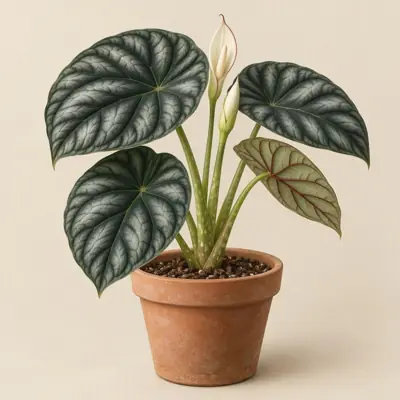
Alocasia baginda is a perennial, small and relatively robust terrestrial herb with a short, upright stem; older plants can form a short, inclined rhizome, while the cultivar 'Dragon Scale' has a compact habit.
Watch: Monstera vs Philodendron vs Alocasia vs Anthurium
Overview
Alocasia baginda is a perennial, small and relatively robust terrestrial herb with a short, upright stem; older plants can form a short, inclined rhizome, while the cultivar 'Dragon Scale' has a compact habit.
Origin and habitat
Sources differ on its origin: it is associated with East Kalimantan on Indonesian Borneo, but its exact wild locality is unknown. Its wild habitat is reported to be unknown; based on the ecology of similar species, it has been suggested that it may be associated with ultramafic or limestone geological environments, pending confirmation after rediscovery in the wild. The genus Alocasia is reported to occur mainly in tropical and subtropical, rainy environments from Asia to eastern Australia.
Characteristics
Sources differ, placing mature height at about 25–30 cm. The leaves are thick, rigid, and prominently textured; 'Dragon Scale' has arrow-shaped leaves with silver-green surfaces and dark green veins, while the species has nearly round to broadly ovate, peltate leaves with matte dark green surfaces and raised pale gray areas. The inflorescences are reported to occur in pairs, with greenish-white peduncles; the spathe is mainly creamy white inside and outside with dark red visible along the margin, and the spadix has female, sterile, and male zones and a pale cream appendage. The infructescence and fruit are reported to be unknown.
Light
Alocasia baginda is generally reported to prefer partial shade to bright shade, avoiding excessively strong direct light; Alocasia generally favors shaded conditions. It is reported to tolerate medium light.
Watering
It is generally recommended to water regularly during active growth and keep the medium moderately moist but well drained, watering again after the surface dries slightly; watering is reduced in winter and prolonged excessive moisture is avoided.
Temperature and dormancy
A hardiness-zone classification is reported for Alocasia baginda. It is reported to be frost tender; keep above freezing.
Growing medium and mounting
It is generally reported to favor a slightly acidic medium rich in humus or organic matter that retains moderate moisture while draining well. It is reported to be rhizomatous and suited to an airy mix.
Feeding
Sources differ on feeding practice during active growth, recommending regular feeding with slow-release or liquid fertilizer from spring through autumn or feeding at regular intervals.
Propagation
It is reported to be propagated by dividing offsets or daughter plants; Alocasia can also be propagated using tuber-related material.
Common problems
It is reported to be susceptible to spider mites, scale insects, aphids, and mealybugs. Reported problems include soft rot, anthracnose, root rot, and leaf spots, with overwatering increasing the risk of root rot. Leaf yellowing is reported to be associated with overwatering, insufficient water, or inadequate light, while excessive moisture may also contribute to root rot and leaf spots. It is frost tender and should be kept above freezing; outdoor plants should also be protected from strong winds.
Identification
Alocasia baginda has a compact habit with thick, strongly textured, silver-green arrow-shaped leaves whose dark green veins create a scale-like appearance; the species can be distinguished from A. melo by its smooth rather than strongly puckered leaf surface and by raised pale gray areas on the dark green leaf surface.
Sources
- GBIF Backbone: Alocasia baginda Kurniawan & P.C.Boyce — CC BY 4.0 · link
- Wikipedia (en): Alocasia baginda — CC BY-SA 4.0 · link
- GBIF descriptions: CATE Araceae — per dataset · link
- NHK みんなの趣味の園芸 植物図鑑: Alocasia (genus-level) — © NHK出版, facts only · link
- NC State Plant Toolbox: Alocasia (genus-level) — copyright (facts only) · link
- Top Tropicals catalog: Alocasia baginda — © Top Tropicals LLC (facts only) · link