
giant caladium (Alocasia cuprea)
Alocasia cuprea is a perennial evergreen foliage plant with a clumping, shrubby habit.
Watch: Monstera vs Philodendron vs Alocasia vs Anthurium
Overview
Alocasia cuprea is a perennial evergreen foliage plant with a clumping, shrubby habit.
Origin and habitat
Alocasia cuprea is native to Borneo. It is tropical, favors warm, highly humid conditions, and does not tolerate frost.
Characteristics
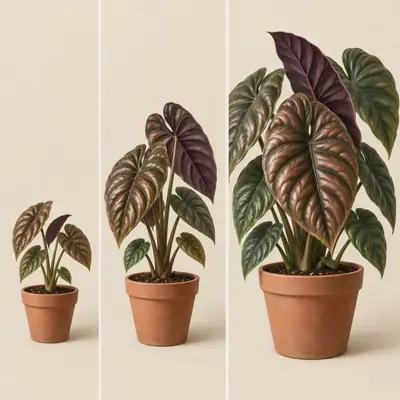
Sources differ on mature height, placing it at about 50–100 cm. A single source reports a mature spread of about 50–100 cm. The large leaves have a pronounced metallic sheen, with upper surfaces ranging from deep bronze and coppery green to silvery tones and undersides from deep purple to reddish purple; greener-leaved forms also occur. Alocasia inflorescences consist of a spadix surrounded by a spathe, with inconspicuous flowers, and orange-red fruit is reported to sometimes form after flowering.
Light
Alocasia cuprea prefers bright indirect light, including bright filtered light, and is suited to partial shade; strong direct light should not be its main growing condition.
Watering
During the growing season, keep the growing medium evenly moist without waterlogging and water when the surface begins to dry; reduce watering substantially in winter.
Humidity and airflow
It is generally reported to prefer high humidity.
Temperature and dormancy
The ideal temperature is 20–25 °C. Sources differ on the minimum temperature, with limited evidence placing it at about 18 °C. It is classified in USDA hardiness zones and the RHS H1A hardiness category. It is generally considered frost tender; keep above freezing.
Growing medium and mounting
Use a moist but well-drained, organic-rich growing medium; loam, sandy, and chalky soils are suitable, as are acidic, neutral, or alkaline conditions. Alocasia cuprea has tuberous roots and favors an airy mix.
Feeding
It is reported to benefit from a general-purpose liquid fertilizer from spring through autumn at regular intervals.
Propagation
Propagation can be by division in spring or summer, while stem cuttings in spring are also recorded.
Common problems
Possible pests include spider mites, scale insects, aphids, and mealybugs. Sources differ on diseases: this species is described as generally having few diseases, while genus-level information associates overly wet conditions with root rot and leaf spot, and other records also list soft rot and anthracnose. A single source reports that overwatering can cause root rot, leaf spots, or yellowing leaves, while insufficient water or light may also cause yellowing. It is sensitive to frost and low temperatures; when grown outdoors, it should be protected from strong winds and placed in a sheltered position.
Identification
Distinctive features include thick, almost mirror-like metallic leaves, coppery-green to deep-bronze upper surfaces, prominent veins, and reddish-purple to deep-purple undersides.
Photos


Sources
- Wikipedia (en): Alocasia cuprea — CC BY-SA 4.0 · link
- RHS Plants: Alocasia cuprea — © RHS, facts only · link
- NHK みんなの趣味の園芸 植物図鑑: Alocasia (genus-level) — © NHK出版, facts only · link
- NC State Plant Toolbox: Alocasia (genus-level) — copyright (facts only) · link
- Top Tropicals catalog: Alocasia cuprea — © Top Tropicals LLC (facts only) · link