
giant taro (Alocasia macrorrhizos)
Alocasia macrorrhizos is a large, evergreen, upright perennial herb with a robust rhizome.
Watch: Monstera vs Philodendron vs Alocasia vs Anthurium
Overview
Alocasia macrorrhizos is a large, evergreen, upright perennial herb with a robust rhizome.
Origin and habitat
Sources differ on its native range, which is described as extending mainly from maritime Southeast Asia into Oceania and northeastern Australia, including Borneo, Sulawesi, the Philippines, the Moluccas, New Guinea, the Bismarck Archipelago, the Solomon Islands and Queensland; prehistoric cultivation and dispersal make the original wild range difficult to determine fully. It occurs in moist lowland tropical to subtropical environments, including rainforest understory, riverbanks, stream margins, moist disturbed ground, secondary forest, valleys and old garden sites. It prefers high-rainfall lowland tropical climates and is widely cultivated and naturalized in tropical and subtropical regions.
Characteristics
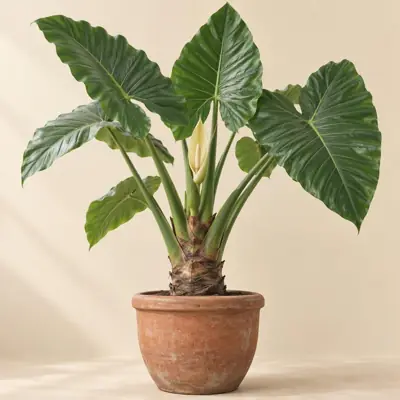
Sources differ on mature height, placing it at about 200–400 cm, while the few available sources report a mature spread of about 150–250 cm. The leaves are very large, bright to medium green and usually upright, with an ovate-arrowhead to bluntly triangular shape and entire to slightly wavy margins. The typical aroid inflorescence consists of a spadix enclosed by a pale green, yellow-green to creamy yellow spathe, with female, sterile and male zones on the spadix; it is reported to flower in summer. The fruit is reported to consist of fleshy berries clustered on the spadix, changing from green to bright red or orange when mature and containing seeds.
Light
It is reported to prefer partial sun, with bright indirect light indoors, and it tolerates some direct sun.
Watering
Keep the growing medium moist but well drained during active growth, avoid waterlogging, and reduce watering in winter.
Humidity and airflow
It generally prefers high humidity.
Temperature and dormancy
Sources differ on the lower temperature guidance, which is around 10 °C. The few available sources report an ideal temperature of about 20–25 °C and an upper temperature of around 32 °C. It is frost tender; keep above freezing.
Growing medium and mounting
It prefers well-drained, humus-rich, fertile loam but can adapt to soils ranging from sandy to heavy clay; prolonged waterlogging should be avoided. It is rhizomatous and prefers an airy mix.
Feeding
Regular feeding can be provided during the growing period from spring through autumn, with sources describing either general liquid fertilizer or slow-release and fast-acting fertilizer schedules.
Propagation
It can be propagated by seed or rhizome division; mature seed may be sown after collection, and rhizomes may be divided in spring. Other sources also describe vegetative propagation using corms, tubers and root suckers.
Common problems
Potential pests include scale insects and spider mites, while Alocasia cultivation information also lists aphids. Sources differ on diseases: RHS describes the species as generally free of serious disease, while NHK cultivation information for Alocasia lists soft rot and anthracnose. Waterlogging is unsuitable, and large plants may need support if they grow too tall. As a tropical plant, it prefers warm, humid and sheltered conditions; in colder regions it requires indoor or greenhouse cultivation, and in northern mainland China it requires indoor overwintering.
Identification
Alocasia macrorrhizos is distinguished by its very large size, robust upright stem or rhizome, and large arrow-shaped leaves that are usually held upright.
Photos


Sources
- GBIF Backbone: Alocasia macrorrhizos (L.) G.Don — CC BY 4.0 · link
- Wikipedia (en): Alocasia macrorrhizos — CC BY-SA 4.0 · link
- 維基百科:海芋 — CC BY-SA 4.0 · link
- Wikipedia (de): Riesenblättriges Pfeilblatt — CC BY-SA 4.0 · link
- Wikipedia (fr): Alocasia macrorrhizos — CC BY-SA 4.0 · link
- GBIF descriptions: Lista de especies de plantas exóticas y trasplantadas de Colombia; Catálogo de Plantas y Líquenes de — per dataset · link
- Useful Tropical/Temperate Plants: Alocasia macrorrhizos — CC BY-NC-SA 3.0 (facts only) · link
- RHS Plants: Alocasia macrorrhizos — © RHS, facts only · link
- USDA PLANTS Database: Alocasia macrorrhizos — Public domain (US Government work) · link
- NHK みんなの趣味の園芸 植物図鑑: Alocasia macrorrhizos — © NHK出版, facts only · link
- NC State Plant Toolbox: Alocasia (genus-level) — copyright (facts only) · link