
Alocasia zebrina (Alocasia zebrina)
Alocasia zebrina is a clumping foliage herb with an underground corm- or tuber-like structure. Sources differ in describing its life cycle, with some describing it as a perennial herb.
Watch: Monstera vs Philodendron vs Alocasia vs Anthurium
Overview
Alocasia zebrina is a clumping foliage herb with an underground corm- or tuber-like structure. Sources differ in describing its life cycle, with some describing it as a perennial herb.
Origin and habitat
Alocasia zebrina is endemic to the Philippines and is explicitly recorded from Luzon, Mindanao, Leyte, Samar, Biliran, and Alabat. It is a subtropical plant suited to warm conditions.
Characteristics
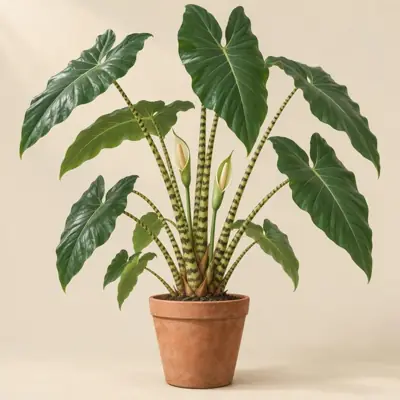
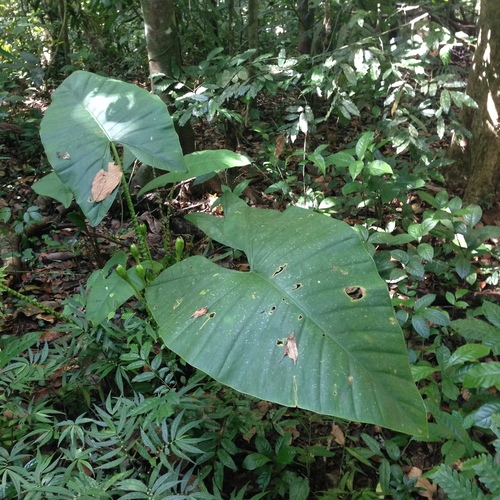
Sources differ on mature height, placing it at about 180–290 cm, while a single source reports a mature spread of about 50–100 cm. The leaves are arrow-shaped, glossy, dark to deep green, and relatively thick, with the leaf base divided into triangular to ovate lobes; juvenile leaves are narrower and longer, becoming broader at maturity. The inflorescences have green, elongated spathes and white spadices and may occur in pairs; a single source reports flowering in summer. The fruit is reported to be orange.
Light
Sources differ on light conditions, describing partial sun to bright indirect light while also listing full sun or partial shade as acceptable.
Watering
During active growth, keep the medium moderately moist without waterlogging, watering thoroughly when it becomes slightly dry or when the leaves begin to wilt; reduce watering in winter.
Humidity and airflow
Alocasia zebrina prefers high humidity.
Temperature and dormancy
Sources differ on the minimum temperature, with limited evidence placing it at about 15 °C. It is generally listed for warm hardiness conditions and is reported to tolerate brief light frost.
Growing medium and mounting
Use an organic-rich medium that retains moisture while draining well; loam with acidic to neutral conditions is also specified. It has tuberous roots.
Feeding
Feed during the growing season; sources recommend either long-lasting balanced fertilizer in spring and summer or general liquid fertilizer from spring through autumn.
Propagation
Alocasia zebrina can be propagated by division, cuttings, seeds, or corms formed by the parent plant.
Common problems
Spider mites and mealybugs may affect Alocasia zebrina, while genus-level information also records scale insects and aphids. One source describes the species as generally having few diseases, while genus-level information associates excessive moisture with root rot and leaf spot and also records soft rot and anthracnose. A single source reports that overwatering, underwatering, or insufficient light may cause yellow leaves and that excessive moisture may lead to root rot or leaf spot. It is sensitive to low temperatures and should be moved indoors during cold spells; mature plants may briefly tolerate light frost, while young plants need protection, and strong outdoor winds should also be avoided.
Identification
The most conspicuous identifying feature is the slender pale-green to green petiole marked with dark-green to brown zebra-like stripes; the leaves are large and arrow-shaped.
Photos



Sources
- Wikipedia (en): Alocasia zebrina — CC BY-SA 4.0 · link
- Wikipedia (fr): Alocasia zebrina — CC BY-SA 4.0 · link
- RHS Plants: Alocasia zebrina — © RHS, facts only · link
- 臺北典藏植物園 植物資料庫: Alocasia zebrina — © 臺北典藏植物園, facts only · link
- NC State Plant Toolbox: Alocasia (genus-level) — copyright (facts only) · link
- Top Tropicals catalog: Alocasia zebrina — © Top Tropicals LLC (facts only) · link