
guinea-fowl aloe (Aloe aristata)
Aloe aristata is a stemless, clump-forming evergreen succulent that grows in rosettes. It is an evergreen perennial.
Overview
Aloe aristata is a stemless, clump-forming evergreen succulent that grows in rosettes. It is an evergreen perennial.
Origin and habitat
It is native to South Africa and Lesotho; South African records include Northern Cape, Eastern Cape, Free State and KwaZulu-Natal, while a German source also lists Western Cape, so sources differ. It is reported from a broad range of natural habitats, including dry, sandy Karoo areas, sandy plains, highland grasslands, cold mountain slopes and shady forest valleys. It is reported to be adapted to conditions ranging from dry regions to cold highland environments and to have some frost tolerance.
Characteristics
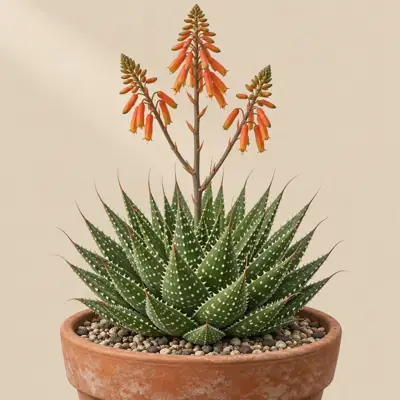
Few sources indicate a mature height of about 10–50 cm and a spread of about 10–50 cm. The soft, succulent, lance-shaped leaves overlap densely in rosettes, with toothed or bristly margins, a long slender threadlike tip, and white spots or stripes; the plant stores water in its leaves. The nectar-rich tubular flowers range from orange to orange-red, can form branched inflorescences, and attract pollinators such as birds and bees. Sources differ on flowering season, describing it as autumn or, in a commercial source, winter.
Light
Aloe aristata takes full sun, and the RHS recommends a sheltered south- or west-facing position. Prolonged direct sunlight may cause the plant to turn reddish brown.
Watering
Water moderately during the growing period and allow the medium to dry between waterings; during winter dormancy, greatly reduce watering and avoid standing water.
Temperature and dormancy
Sources differ on the minimum temperature, placing it around -7 °C, while another claim based on few sources likewise reports around -7 °C. Few sources report an ideal temperature of about 6–10 °C. It is generally reported to be frost hardy and to rest in winter.
Growing medium and mounting
Use a well-drained medium; the RHS recommends peat-free cactus potting mix or a peat-free loam-based potting medium with horticultural grit, and the soil may be acidic, neutral or alkaline. It needs a fast-draining mix.
Feeding
It is reported to benefit from a general liquid fertilizer applied monthly from May through August.
Propagation
It can be propagated from seed sown when ripe or by separating offsets; offsets can be divided in spring or early summer and rooted in cactus potting medium.
Common problems
Scale insects and mealybugs are reported as possible pests, while diseases are generally reported to be uncommon. Overwatering and standing water in the pot are major cultivation problems, with watering especially restricted in winter. It is reported to have moderate frost tolerance, but in extremely cold temperate regions it may need to be moved indoors or into a greenhouse for winter.
Identification
Aloe aristata is identifiable as a stemless rosette succulent with white leaf markings, toothed or bristly leaf margins, and conspicuous long, slender, threadlike leaf tips; during drought the rosette can close inward into a nearly spherical shape.
Photos


Sources
- GBIF Backbone: Aloe aristata Haw. — CC BY 4.0 · link
- Wikipedia (en): Aristaloe — CC BY-SA 4.0 · link
- 維基百科:绫锦芦荟属 — CC BY-SA 4.0 · link
- Wikipedia (de): Aloe aristata — CC BY-SA 4.0 · link
- Wikipedia (fr): Aloe aristata — CC BY-SA 4.0 · link
- Wikipedia (es): Aristaloe aristata — CC BY-SA 4.0 · link
- RHS Plants: Aloe aristata — © RHS, facts only · link
- Aloe aristata | Giromagi cactus and succulents for sale | Buy plants online (www.giromagi.com) — facts only (§12) · link