
soap aloe (Aloe maculata)
Aloe maculata is an evergreen succulent perennial that is stemless or short-stemmed, with leaves forming tight rosettes and basal offsets that develop into clumps or spreading colonies.
Overview
Aloe maculata is an evergreen succulent perennial that is stemless or short-stemmed, with leaves forming tight rosettes and basal offsets that develop into clumps or spreading colonies.
Origin and habitat
Sources differ on its native range in southern Africa, describing it mainly from South Africa and also from Botswana, Zimbabwe, Lesotho, and Eswatini. It is adapted to warm, dry, sunny conditions and tolerates heat, drought, and salt, making it suited to coastal environments. It is reported from varied southern African habitats, including rocky grassland slopes, dry savanna, and arid areas.
Characteristics
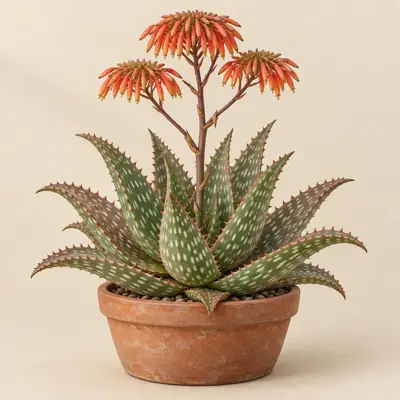
Few sources report a mature height of about 50–100 cm and a spread of about 50–100 cm. The fleshy, lance-shaped leaves form dense rosettes and range from green to reddish green, becoming red, brown, or purple with changes in light; they have conspicuous white or pale spots and sharp brown marginal teeth. The tubular flowers range from yellow, orange, and salmon-pink to red, forming dense, typically flat-topped, head-like, or nearly spherical clusters on tall, often branched flower stalks; sources differ on the flowering season according to region and cultivation climate. Aloe maculata is reported to store water in its leaves.
Light
Aloe maculata takes full sun and also grows in bright filtered light; stronger sunlight can turn the leaves red or reddish brown.
Watering
Water moderately to regularly during active growth in a well-drained medium, but reduce watering markedly and keep it relatively dry during winter dormancy or cool periods.
Temperature and dormancy
Few sources report a minimum of about 0 °C. It is generally frost tender; keep above freezing. It rests in winter and is reported to continue growing in hot conditions, with summer growth generally not slowing. Hardiness information is given using both USDA zones and an RHS hardiness rating.
Growing medium and mounting
Use a well-drained medium; sources describe loam or a light, fertile, well-drained soil, as well as cactus potting medium with horticultural grit, while differing on whether the preferred pH is slightly acidic, acidic, neutral, or alkaline.
Feeding
A general liquid fertilizer is reported as suitable for regular feeding during part of the growing season.
Propagation
Aloe maculata can be propagated from basal offsets, by division of older plants, or from seed; leaf cuttings are also recorded as a method.
Common problems
Mealybugs, spider mites, and scale insects are reported as possible pests, while diseases are generally reported to be uncommon. Poor drainage and excessive winter watering do not meet its cultivation needs, while proliferating offsets can gradually cover a larger area and may require division. Cold and frost can cause damage, whereas the plant tolerates heat, drought, and salt; sources differ on the lowest temperature it can withstand.
Identification
Aloe maculata has numerous conspicuous leaf spots, described by some sources as H-shaped markings, and its dense flower clusters are often flat-topped; it readily produces offsets that form large colonies.
Photos


Sources
- Wikipedia (en): Aloe maculata — CC BY-SA 4.0 · link
- Wikipedia (de): Aloe maculata — CC BY-SA 4.0 · link
- Wikipedia (fr): Aloe maculata — CC BY-SA 4.0 · link
- Wikipedia (es): Aloe maculata — CC BY-SA 4.0 · link
- GBIF descriptions: DAISIE - Inventory of alien invasive species in Europe — per dataset · link
- LLIFLE Encyclopedia of living forms: Aloe maculata — CC BY-SA · link
- RHS Plants: Aloe maculata — © RHS, facts only · link
- The Succulent Plant Page: Aloe (genus-level) — © R.J. Hodgkiss, facts only · link
- NHK みんなの趣味の園芸 植物図鑑: Aloe (genus-level) — © NHK出版, facts only · link
- NC State Plant Toolbox: Aloe (genus-level) — copyright (facts only) · link
- PUKUBOOK: Aloe maculata — CC BY-NC (facts only) · link