
Basotoland aloe (Aloe polyphylla)
Sources differ in describing Aloe polyphylla as an evergreen succulent perennial that is stemless or has only a very short stem, forming low, compact rosettes that may grow in dense groups. It is an evergreen perennial.
Overview
Sources differ in describing Aloe polyphylla as an evergreen succulent perennial that is stemless or has only a very short stem, forming low, compact rosettes that may grow in dense groups. It is an evergreen perennial.
Origin and habitat
Sources differ on details of its native range, but describe Aloe polyphylla as endemic to Lesotho and occurring mainly in the Maloti/Drakensberg mountains. It inhabits high-altitude mountain grass slopes, steep basalt slopes, scree and rock crevices, often in moist but well-drained sites. Its alpine climate is cool and wet in summer, with high summer rainfall and frequent cloud or mist; winters are cold, and wild plants are often covered by snow.
Characteristics
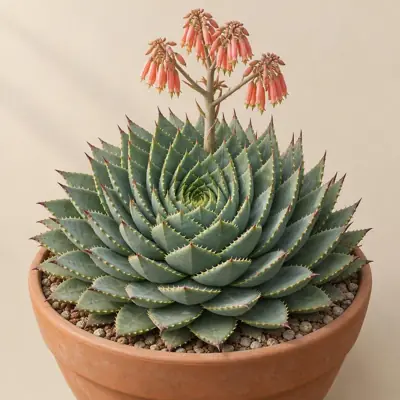
Mature plants reach 10–50 cm in height; sources differ on spread, giving about 50–100 cm. Under suitable conditions it can grow relatively quickly and reach full size after several years. Sources differ in details, but the numerous fleshy, grey-green to blue-green leaves are broad, thick and tapering, with toothed or spiny margins and a dark to purplish-brown spine at the tip; mature rosettes arrange their leaves in regular clockwise or counterclockwise spirals. The plant stores water in its leaves, and its stout, branched inflorescences bear dense flowers that are usually red to salmon-pink, with sources differing on whether yellow flowers also occur; flowering is from spring to early summer.
Light
Aloe polyphylla takes full sun and requires ample light in cultivation.
Watering
Water moderately during active growth and very sparingly during winter dormancy, using a well-drained growing medium; although its native habitat receives ample summer moisture and rainfall, this does not imply persistently waterlogged potting medium.
Temperature and dormancy
Aloe polyphylla is frost hardy and rests in winter, with a minimum temperature of -20 °C. A specialist single source reports an upper temperature of about 30 °C, so sources are few for this figure. A single source reports its hardiness as RHS H2. High temperatures can slow or stop growth, and the plant is not suited to hot conditions.
Growing medium and mounting
Use well-drained loam or a succulent growing medium, such as peat-free cactus compost or peat-free loam-based compost with horticultural grit; in its native habitat it also occurs in well-drained, organic-rich soil and basalt rubble, and the medium may be acidic, neutral or alkaline. Specialist single sources report that Aloe polyphylla is prone to rot and needs a very fast-draining mix.
Feeding
A single source recommends applying a general-purpose liquid fertilizer regularly during part of the growing season.
Propagation
Sources differ on propagation details, but propagation can be by seed or by separating offsets and rooting them in cactus compost.
Common problems
A single source reports that scale insects and mealybugs may be pests. Sources differ, but disease is generally reported to be uncommon. Unsuitable growing conditions can readily kill the plant; high temperatures may slow or stop growth, while shade can make the characteristic spiral leaf arrangement less distinct. It is adapted to cool alpine conditions and winter snow, is more sensitive to hot environments, and in the wild can experience nighttime temperatures far below freezing.
Identification
Its most striking identifying feature is the highly regular, nearly symmetrical spiral arrangement of the leaves, which may turn either left or right.
Photos


Sources
- Wikipedia (en): Aloe polyphylla — CC BY-SA 4.0 · link
- 維基百科:多葉蘆薈 — CC BY-SA 4.0 · link
- Wikipedia (de): Aloe polyphylla — CC BY-SA 4.0 · link
- Wikipedia (fr): Aloe polyphylla — CC BY-SA 4.0 · link
- Wikipedia (es): Aloe polyphylla — CC BY-SA 4.0 · link
- LLIFLE Encyclopedia of living forms: Aloe polyphylla — CC BY-SA · link
- RHS Plants: Aloe polyphylla — © RHS, facts only · link
- The Succulent Plant Page: Aloe (genus-level) — © R.J. Hodgkiss, facts only · link
- NHK みんなの趣味の園芸 植物図鑑: Aloe (genus-level) — © NHK出版, facts only · link
- Aloe polyphylla | Giromagi cactus and succulents | Buy plants online (www.giromagi.com) — facts only (§12) · link
- PUKUBOOK: Aloe polyphylla — CC BY-NC (facts only) · link