
Coral Aloe (Aloe striata)
Aloe striata is a perennial evergreen succulent, usually forming a basal rosette and generally lacking a stem or having only a very short one; it is usually solitary, though some older plants or individuals can develop a short stem or limited branching.
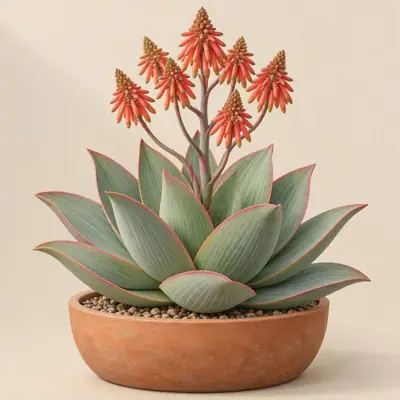
Overview
Aloe striata is a perennial evergreen succulent, usually forming a basal rosette and generally lacking a stem or having only a very short one; it is usually solitary, though some older plants or individuals can develop a short stem or limited branching.
Origin and habitat
It is native to South Africa, mainly in the Western Cape and Eastern Cape, including the southern Cape Floristic Region. It occurs from coastal areas to the drier Karoo, often on rocky slopes, stony hills, grassland, or scrub. Its native environments include southern South African coastal and dry inland areas; it is also described as occurring mainly in a subtropical biome and as drought tolerant.
Characteristics
Sources differ on mature height, placing it at about 50–100 cm, while mature spread is 50–100 cm. Seedlings are reported to grow relatively quickly and can reach flowering size within several years. The broad, thick leaves form rosettes and are silver-green to blue-green, sometimes reddening with sun exposure or low temperatures; they usually have fine longitudinal stripes and smooth, toothless margins colored pink to nearly red, and the plant stores water in its leaves. The tubular flowers are coral-red to orange-red and are borne on tall, branching panicles that can have a relatively flat top; sources differ on flowering time, describing it from winter into spring or in spring.
Light
Aloe striata takes full sun and can also accept bright conditions or light shade; in hot areas, strong summer afternoon sun and reflected heat are best avoided.
Watering
It requires good drainage and moderate watering during growth without overwatering; sources differ in their descriptions, with some characterizing it as mainly winter-growing and drought tolerant.
Temperature and dormancy
Its stated minimum temperature is -5 °C, and it is described as frost hardy. It rests in winter. In summer it should be protected from afternoon sun and reflected heat, and in very hot areas its leaves can turn red.
Growing medium and mounting
It needs a fast-draining mix; well-drained soil is suitable, including loam, peat-free cactus compost for containers, or loam-based compost amended with horticultural grit, and it can adapt to acidic, neutral, or alkaline pH.
Feeding
RHS reportedly recommends applying a general liquid fertilizer monthly from May through August.
Propagation
It can be propagated from fresh seed or by division, including separating offsets in spring or early summer. Fresh seed germinates readily in a well-drained medium and can germinate quickly under the stated conditions.
Common problems
Possible pests include scale insects, mealybugs, and aloe weevils. Sources differ on disease issues: LLIFLE mentions aloe rust, while RHS describes the species as generally having few disease problems. Overwatering and poor drainage are unfavorable, while drought, cold, or other stress can cause the leaves to turn red. It is drought tolerant, and strong afternoon sun and reflected heat should be avoided in hot conditions; sources differ on its cold tolerance, with some reporting tolerance of freezing temperatures and another recommending that freezing be avoided.
Identification
Key identifying features are broad, thick, striped blue-green leaves with completely smooth, spineless pink margins and coral-red flowers; the smooth margins and red flowers distinguish Aloe striata from Aloe reynoldsii, which has toothed, waxy leaf margins and yellow flowers.
Photos


Sources
- Wikipedia (en): Aloe striata — CC BY-SA 4.0 · link
- 維基百科:線條蘆薈 — CC BY-SA 4.0 · link
- Wikipedia (de): Aloe striata — CC BY-SA 4.0 · link
- Wikipedia (fr): Aloe striata — CC BY-SA 4.0 · link
- Wikipedia (es): Aloe striata — CC BY-SA 4.0 · link
- LLIFLE Encyclopedia of living forms: Aloe striata — CC BY-SA · link
- RHS Plants: Aloe striata — © RHS, facts only · link
- Desert-Tropicals: Aloe striata — © Philippe Faucon (desert-tropicals.com), facts only · link
- The Succulent Plant Page: Aloe (genus-level) — © R.J. Hodgkiss, facts only · link
- NHK みんなの趣味の園芸 植物図鑑: Aloe (genus-level) — © NHK出版, facts only · link
- NC State Plant Toolbox: Aloe (genus-level) — copyright (facts only) · link
- Top Tropicals catalog: Aloe striata — © Top Tropicals LLC (facts only) · link
- Aloe striata | Giromagi cactus and succulents for sale | Buy plants online (www.giromagi.com) — facts only (§12) · link