
tree aloe (Aloidendron barberae)
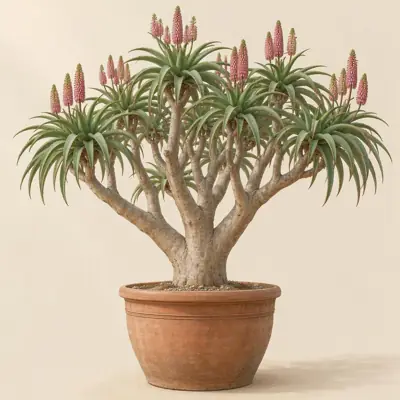
Aloidendron barberae is a large tree-like succulent with a stout upright trunk, extensive repeated forking when mature, and a tall, rounded crown. It is reported to be a long-lived perennial.
Overview
Aloidendron barberae is a large tree-like succulent with a stout upright trunk, extensive repeated forking when mature, and a tall, rounded crown. It is reported to be a long-lived perennial.
Origin and habitat
It is native to eastern parts of southern Africa, from South Africa's Eastern Cape through KwaZulu-Natal, Mpumalanga and Eswatini northward to Mozambique; some sources also record its range as extending into East Africa. It occurs in summer-rainfall regions in subtropical coastal forest, wooded ravines or gullies, dry valleys, dense thicket and low forest, including some steep slopes. Its native climate is reported to be mild and summer-rainfall, with little or no frost.
Characteristics
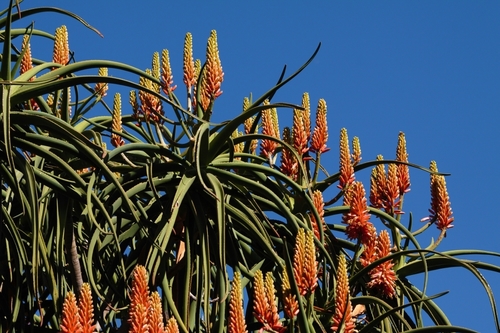
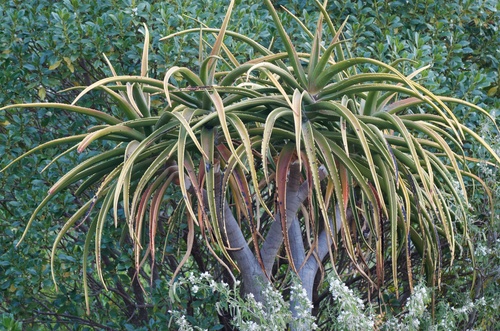
Sources differ on mature height, giving a range of about 1500–2000 cm. Sources also differ on growth rate, describing it as slow in the wild but fairly fast in cultivation under favorable conditions. Sources differ in their descriptions of the foliage and flowers: leaves form dense rosettes at branch tips and are sword-shaped, deeply channelled and recurved, with narrow whitish margins and stiff, brown-tipped teeth; the tubular flowers are mainly rose-pink to pink with green tips, borne in dense cylindrical racemes on upright inflorescences, while orange flowers are also recorded for the Maputaland coastal form. Sources differ on flowering time but place it in winter in the native range; the fruit is reported to be a dry capsule that matures in late spring and releases seeds that can be dispersed by wind.
Light
Aloidendron barberae takes full sun, while young plants can tolerate some shade.
Watering
It is reported to be grown in a well-drained medium and, for best growth, can be watered generously when supplied with adequate compost; it is also used in drought-tolerant landscapes.
Humidity and airflow
It generally needs good airflow.
Temperature and dormancy
The few source accounts indicate a cold minimum of about 0 °C. It is reported to tolerate brief light frost.
Growing medium and mounting
It prefers well-drained soil, with slopes considered especially suitable; soils in its native habitat are usually loamy and rich in humus. It needs a fast-draining mix and is reported to have low rot risk.
Feeding
Under favorable growing conditions, an ample supply of compost is reported to support best growth.
Propagation
Sources differ in their propagation descriptions, but report that it can be propagated readily from thick branch or trunk sections and that cuttings should be allowed to dry before planting. Propagation methods also include stem cuttings and seed; sources report that its seeds can germinate and are dispersed by wind.
Common problems
Leaves are reported to be susceptible to aphids and scale insects. Improper watering, poor drainage or excessive shade is reported to increase pest and disease risk, while rot is generally less problematic with appropriate airflow and watering. It should not be planted between buildings or where root space is restricted because its massive trunk and root system require adequate room to expand, and it can be overtopped, suppressed and killed by faster-growing plants. Its native environment is reported to experience little or no frost.
Identification
Aloidendron barberae is one of the largest African aloe-like plants, distinguished by its massive trunk, repeated forking and rosettes of leaves at branch tips. Among large tree aloes in KwaZulu-Natal, it can be distinguished from Aloidendron tongaense by its greater branching, long leaves and elongated cylindrical pink inflorescences.
Photos


Sources
- Wikipedia (en): Aloidendron barberae — CC BY-SA 4.0 · link
- Wikipedia (de): Aloe barberae — CC BY-SA 4.0 · link
- Wikipedia (fr): Aloidendron barberae — CC BY-SA 4.0 · link
- Wikipedia (es): Aloidendron barberae — CC BY-SA 4.0 · link
- GBIF descriptions: A synoptic review of the aloes (Asphodelaceae, Alooideae) of KwaZulu-Natal, an ecologically diverse — per dataset · link
- LLIFLE Encyclopedia of living forms: Aloidendron barberae — CC BY-SA · link
- PUKUBOOK: Aloidendron barberae — CC BY-NC (facts only) · link