
Lemon Bee-brush (Aloysia citrodora)
Aloysia citrodora is a perennial deciduous shrub or subshrub and may have a clumping habit; sources describe its habit differently.
Overview
Aloysia citrodora is a perennial deciduous shrub or subshrub and may have a clumping habit; sources describe its habit differently.
Origin and habitat
It is native to South America; sources explicitly include Argentina, Chile, Peru, and Uruguay, while some also extend its native range to Bolivia, Ecuador, Paraguay, Brazil, Colombia, and Venezuela, so accounts differ. It occurs in fields, along roadsides, and in open scrub, with its native habitat extending from low elevations into mountainous areas. It is native to subtropical or Andean parts of South America and can adapt from semi-arid to humid tropical environments, but has limited cold tolerance in temperate climates.
Characteristics
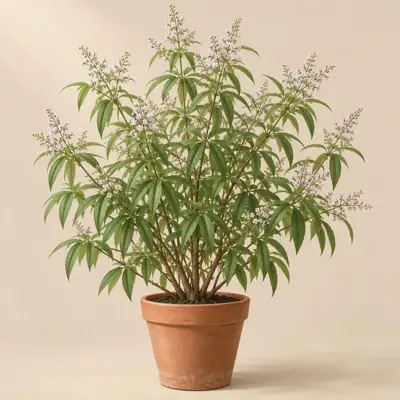
Sources differ on mature size, placing height at about 100–300 cm; the few available sources report a spread of about 150–250 cm. Growth is generally reported to be moderate. The leaves have a strong lemon scent, especially when rubbed or damaged; they are usually narrowly lance-shaped to ovate-lance-shaped with pointed tips, commonly occur in whorls, and are pale green with surfaces that may be glossy. The small flowers range from white to pale purple or purplish white and form spike-like or panicled inflorescences; sources differ in their descriptions of flowering time, while the fruit is reported to split at maturity into elongated, chestnut-brown segments that are flat-convex with projecting tips, and another account describes it as comprising small nutlets.
Light
It prefers full sun and a sheltered position.
Watering
During active growth it prefers a supply of moisture and moderately moist soil, together with good drainage to avoid waterlogging.
Temperature and dormancy
Sources differ on the lower temperature limit, with the limited available information placing it at about -10 °C. The few available sources report an ideal temperature range of about 18–28 °C and an upper temperature of about 33 °C.
Growing medium and mounting
It prefers well-drained, moderately fertile and relatively light soil; loam, sandy soil, or chalky soil may be suitable. Sources describe acidic, neutral, and alkaline soils as suitable, with another source giving a narrower preferred and tolerated soil reaction.
Propagation
It can be propagated by seed or cuttings, with softwood cuttings specifically recommended by RHS.
Common problems
It is generally reported to have few pest problems and few disease problems, with a source also recording notable resistance to honey fungus. Potted plants may fail to flower, and without pruning, branching may produce an untidy form. It is sensitive to cold; sufficiently low temperatures may cause leaf fall or severe damage to new growth, prolonged or severe frost may damage small branches, and still lower temperatures may kill the entire plant.
Identification
Its most distinctive feature is reported to be the strong lemon scent released when the leaves are rubbed; the leaves commonly occur in whorls, and the plant bears small white to pale purple flowers.
Photos


Sources
- Wikipedia (en): Aloysia citrodora — CC BY-SA 4.0 · link
- Wikipedia (ja): レモンバーベナ — CC BY-SA 4.0 · link
- Wikipedia (de): Zitronenstrauch — CC BY-SA 4.0 · link
- Wikipedia (fr): Aloysia citrodora — CC BY-SA 4.0 · link
- Wikipedia (es): Aloysia citrodora — CC BY-SA 4.0 · link
- Useful Tropical/Temperate Plants: Aloysia citrodora — CC BY-NC-SA 3.0 (facts only) · link
- RHS Plants: Aloysia citrodora — © RHS, facts only · link
- USDA PLANTS Database: Aloysia citrodora — Public domain (US Government work) · link