
Joseph's-coat (Amaranthus tricolor)
Amaranthus tricolor is an annual herb with an upright or ascending, sometimes branching habit, and its stems may be green or red.
Overview
Amaranthus tricolor is an annual herb with an upright or ascending, sometimes branching habit, and its stems may be green or red.
Origin and habitat
Sources differ on its native range, variously placing it in tropical Asia, South Asia, Southeast Asia, or India, while long and widespread cultivation has made its original wild distribution unclear. It is widely cultivated in agricultural, horticultural, and home settings, while escaped plants occur in cultivated fields, floodplains, roadsides, and wasteland. It favors warm tropical to warm-temperate conditions, tolerates heat but not frost, and can be cultivated across a variety of climate regions.
Characteristics
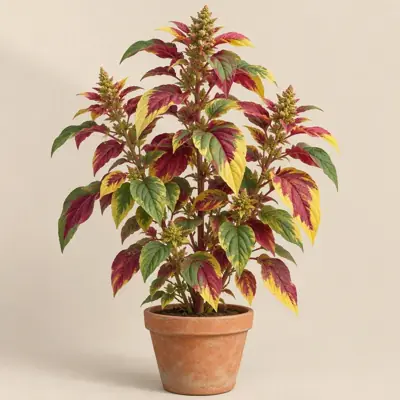
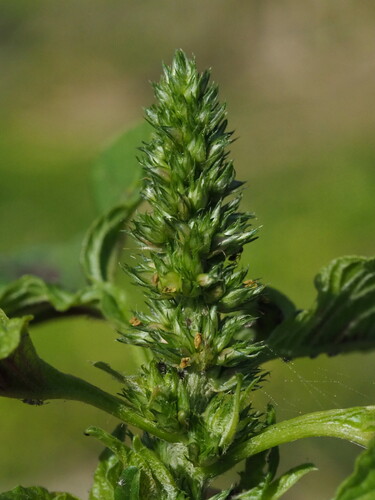
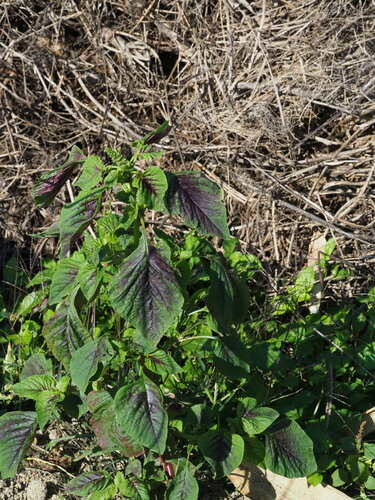
Sources differ on mature height, placing it at about 50–200 cm, while a single source reports a mature spread of about 10–50 cm. It grows rapidly in warm conditions, and its alternate, stalked leaves vary from ovate and rhombic-ovate to lanceolate, with green, yellow, red, purplish-red, or mixed coloration that can be especially conspicuous on the upper new leaves. The small, inconspicuous flowers range from yellow-green or green to red and form dense axillary clusters or spike-like inflorescences; the plant's ornamental interest comes primarily from its foliage rather than its flowers. The fruit is a small ovate to nearly spherical or elliptical capsule that splits open at the top when mature, containing glossy black to brown seeds that are flattened-round to lens-shaped.
Light
Sources differ somewhat on light: full sun is the main recommendation, though the plant can tolerate partial sun, and some horticultural sources recommend afternoon shade in hot conditions.
Watering
Keep conditions moderately moist but well drained, avoiding prolonged waterlogging or excessive moisture; some sources also describe the plant as having some drought tolerance.
Humidity and airflow
A single source reports that Amaranthus tricolor prefers high humidity.
Temperature and dormancy
A single source reports an ideal temperature range of about 22–30 °C. With few sources available, reported lower and upper temperature figures are about 8 °C and about 45 °C, respectively. It is generally reported to be frost tender; keep above freezing.
Growing medium and mounting
Amaranthus tricolor adapts to clay, loam, sandy, and calcareous soils; in horticultural cultivation it favors fertile, humus-rich, moderately moist but well-drained soil and can adapt to neutral through alkaline conditions.
Feeding
Avoid excessive fertilization, which may cause the vivid foliage colors to fade.
Propagation
Amaranthus tricolor can be propagated from seed by direct sowing; sources indicate that the seeds are inhibited by light and should be covered with soil after sowing.
Common problems
Aphids may affect the plant, and blight, root rot, and viral diseases may occur. Prolonged excessive soil moisture may lead to root rot, while excessive fertilization may dull the ornamental foliage color. The plant favors heat and tolerates high temperatures, but it has low cold tolerance and is sensitive to frost; sufficiently low temperatures may be fatal.
Identification
Its most conspicuous feature is multicolored foliage in green, yellow, and red, with especially vivid upper leaves in some cultivars, while the flowers are comparatively inconspicuous.
Photos


Sources
- GBIF Backbone: Amaranthus tricolor L. — CC BY 4.0 · link
- Wikipedia (en): Amaranthus tricolor — CC BY-SA 4.0 · link
- 維基百科:苋 — CC BY-SA 4.0 · link
- Wikipedia (ja): ハゲイトウ — CC BY-SA 4.0 · link
- Wikipedia (de): Dreifarbiger Fuchsschwanz — CC BY-SA 4.0 · link
- Wikipedia (fr): Amaranthus tricolor — CC BY-SA 4.0 · link
- Wikipedia (es): Amaranthus tricolor — CC BY-SA 4.0 · link
- GBIF descriptions: Lista de especies de plantas exóticas y trasplantadas de Colombia; Catálogo de Plantas y Líquenes de — per dataset · link
- NC State Plant Toolbox: Amaranthus tricolor — copyright (facts only) · link
- Wikipedia (pt): Tampala — CC BY-SA 4.0 · link
- Wikipedia (ko): 비름 — CC BY-SA 4.0 · link
- Useful Tropical/Temperate Plants: Amaranthus tricolor — CC BY-NC-SA 3.0 (facts only) · link
- RHS Plants: Amaranthus tricolor — © RHS, facts only · link
- USDA PLANTS Database: Amaranthus tricolor — Public domain (US Government work) · link