
garden snapdragon (Antirrhinum majus)
Antirrhinum majus is an upright to slightly trailing herbaceous plant whose base or stems may become woody with age. It is a short-lived perennial, commonly grown horticulturally as an annual and, in some regions, as a biennial.
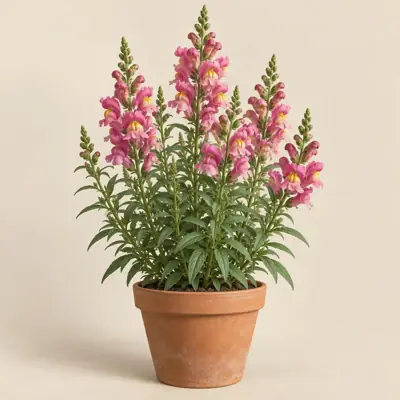
Overview
Antirrhinum majus is an upright to slightly trailing herbaceous plant whose base or stems may become woody with age. It is a short-lived perennial, commonly grown horticulturally as an annual and, in some regions, as a biennial.
Origin and habitat
Sources differ on the native range, describing a Mediterranean distribution encompassing southern and southwestern Europe and North Africa and extending eastward to Turkey and Syria. In the wild, it commonly occurs on rocky ground, in rock crevices, on stone walls, in dry sites, and on scree slopes. It is suited to sunny, well-drained conditions; sources differ in their descriptions but indicate that persistently high heat, high humidity, or extreme cold are unfavorable.
Characteristics
Sources differ on mature height, reporting a range of about 15–200 cm; the few sources for mature spread report about 10–50 cm. The simple, usually hairless leaves range from narrow and elongated to elliptic, ovate, or lanceolate, may be opposite or spirally arranged, and lack stipules. The flowers form elongated terminal spike-like to raceme-like inflorescences; individual flowers are bilaterally symmetrical and two-lipped with a closed corolla throat, occur in red, pink, orange, yellow, white, purple, or multiple colors, and wild forms are commonly pink to purple with a yellow lip. Sources differ on flowering season, describing flowering from late winter or spring through autumn depending on the cultivation climate; the fruit is generally reported to be an ovoid capsule that releases many tiny seeds when mature, either by splitting or through openings, and may have a skull-like appearance.
Light
Full sun is best, though partial sun or light partial shade is also acceptable, and ample sunlight supports growth and flowering.
Watering
Maintain moderate moisture while avoiding standing water and prolonged wetness, use a well-drained medium, avoid watering from above the plant, and reduce watering when growth slows in winter.
Humidity and airflow
Antirrhinum majus is reported to prefer low humidity and need good airflow.
Temperature and dormancy
Antirrhinum majus is reported to tolerate brief light frost.
Growing medium and mounting
Loose, fertile or humus-rich, well-drained soil is preferred; the plant can grow in loamy, sandy, or calcareous soils, adapts well to neutral to alkaline soils, and is also reported to tolerate acidic soil.
Feeding
Liquid fertilizer is generally reported to be suitable for regular application during cultivation.
Propagation
Antirrhinum majus can be propagated by seed, cuttings, or tissue culture, and plants in suitable sites may also reproduce by self-sowing; stem-tip cuttings can be taken in spring or autumn.
Common problems
It is reported to be particularly susceptible to rust and may also experience mold problems, fungal leaf spots, downy mildew, wilt, and root rot. Growth may weaken in hot summer conditions, persistent wetness or poor drainage can be unfavorable, and tall cultivars may need support if they lodge. It is sensitive to high humidity, waterlogging, and extreme cold, and some sources also indicate that high summer temperatures can reduce growth or flowering.
Identification
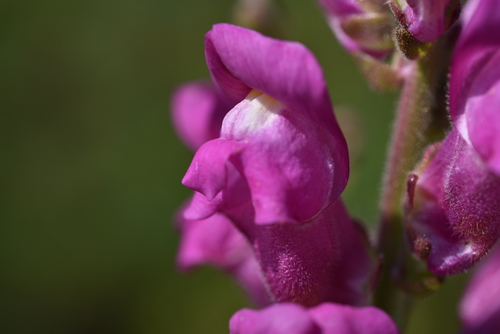
The most distinctive features are the large, bilaterally symmetrical, two-lipped flowers; the upper and lower corolla lips are normally closed but open like a mouth when squeezed from the sides or forced apart by a sufficiently strong bumblebee.
Photos


Sources
- Wikipedia (en): Antirrhinum majus — CC BY-SA 4.0 · link
- 維基百科:金鱼草 — CC BY-SA 4.0 · link
- Wikipedia (ja): キンギョソウ — CC BY-SA 4.0 · link
- Wikipedia (de): Großes Löwenmaul — CC BY-SA 4.0 · link
- Wikipedia (fr): Muflier à grandes fleurs — CC BY-SA 4.0 · link
- Wikipedia (es): Antirrhinum majus — CC BY-SA 4.0 · link
- GBIF descriptions: Manual of the Alien Plants of Belgium; Checklist of introduced taxa in Cyprus; Database of Vascular — per dataset · link
- NC State Plant Toolbox: Antirrhinum majus — copyright (facts only) · link
- Useful Tropical/Temperate Plants: Antirrhinum majus — CC BY-NC-SA 3.0 (facts only) · link
- RHS Plants: Antirrhinum majus — © RHS, facts only · link
- USDA PLANTS Database: Antirrhinum majus — Public domain (US Government work) · link