
Anubias barteri (Anubias barteri)
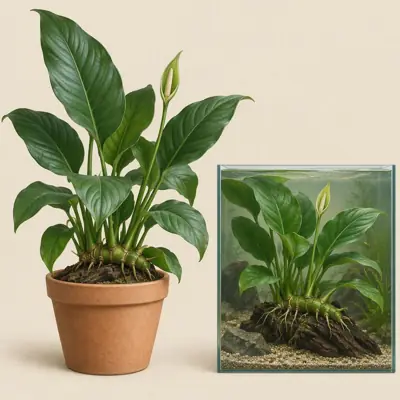
Anubias barteri is a herbaceous plant with a thick, creeping rhizome and can grow partly or fully submerged.
Overview
Anubias barteri is a herbaceous plant with a thick, creeping rhizome and can grow partly or fully submerged.
Origin and habitat
Sources differ in describing its native range, placing it from West Africa into west-central Africa and explicitly listing Guinea, Liberia, Ivory Coast, Nigeria, Cameroon, Bioko Island in Equatorial Guinea, Gabon, and Congo. It is associated with river environments, where it can grow firmly attached and adapt to partly or fully submerged conditions.
Characteristics
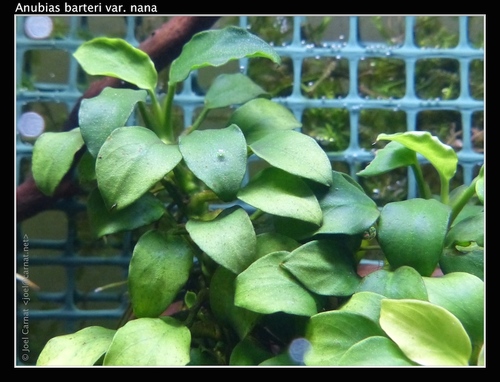
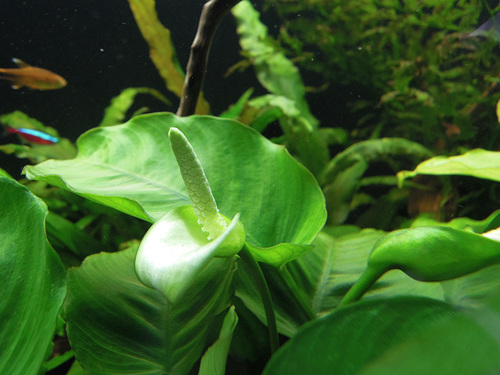
The leaves are upright, green, hairless, and highly variable in shape, ranging from ovate and ovate-lanceolate to narrow and elongated; some descriptions characterize them as leathery. The inflorescence is reported to have a slender, cylindrical spadix and a green, elongated spathe with a pointed tip that opens near the base during flowering.
Light
It is reported to tolerate a broad range of light conditions, including low light. Under stronger light, it is reported to produce faster leaf growth and a more compact form.
Watering
It is reported to be suitable for cultivation partly or fully submerged.
Temperature and dormancy
Few-source information reports a temperature range of about 22 °C to 28 °C.
Growing medium and mounting
Anubias barteri is rhizomatous. The rhizome is generally kept at the surface of the substrate and can be secured to objects such as rocks or wood rather than buried in the substrate.
Propagation
It is reported to be propagated by dividing the rhizome or separating side shoots.
Common problems
The rhizome is reported to be at risk of rotting if buried in the substrate.
Identification
It has a thick, creeping rhizome that roots firmly; the rhizome is typically kept at the substrate surface and can attach to rocks or wood.
Photos


Sources
- GBIF Backbone: Anubias barteri Schott — CC BY 4.0 · link
- Wikipedia (en): Anubias barteri — CC BY-SA 4.0 · link
- Wikipedia (fr): Anubias barteri — CC BY-SA 4.0 · link
- GBIF descriptions: CATE Araceae; A checklist of rheophytes of Cameroon — per dataset · link
- Wikipedia (it): Anubias barteri — CC BY-SA 4.0 · link