
Alexandra palm (Archontophoenix alexandrae)
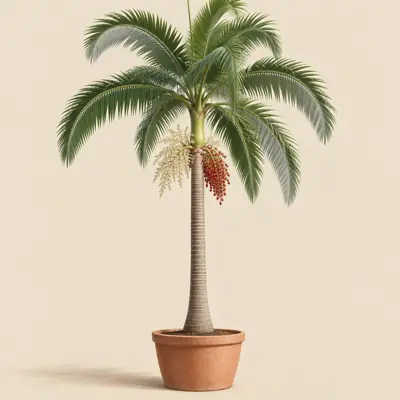
Archontophoenix alexandrae is a tall, evergreen, perennial palm with a single trunk and an upright, columnar habit.
Overview
Archontophoenix alexandrae is a tall, evergreen, perennial palm with a single trunk and an upright, columnar habit.
Origin and habitat
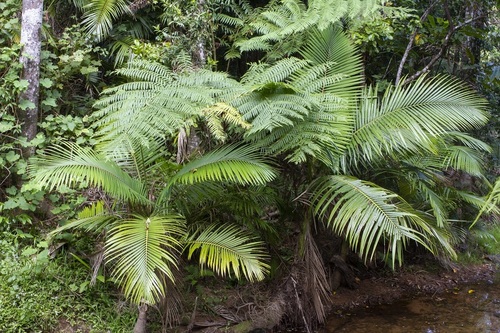
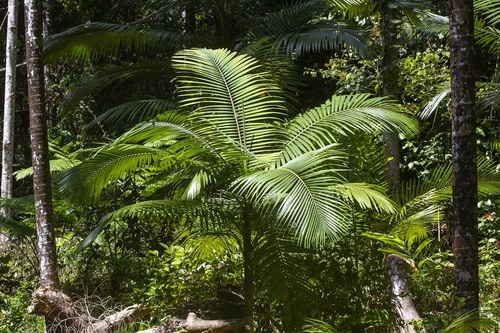
Archontophoenix alexandrae is native to eastern Queensland, Australia, with more detailed accounts placing its range from northeastern to central-eastern Queensland, extending from the Melville Range area of Cape York Peninsula south to beyond Gladstone. Sources differ on habitat details, but describe it as native to tropical rainforest, especially lowland riverine rainforest and areas near waterways and swamps, including sites subject to severe flooding during heavy rain, from sea level into higher elevations. It favors warm, frost-free tropical to subtropical climates and can also be cultivated in cooler frost-free areas outside the tropics.
Characteristics
Sources differ on mature height, placing it at about 2000–3000 cm, while a single source reports a mature spread of about 400–800 cm. It grows rapidly and bears large, arching pinnate leaves with numerous narrow leaflets; the upper leaflet surfaces are green, the undersides gray to silvery gray, and the leaves are often slightly twisted sideways. Large panicles emerge near the base of the crownshaft, bearing small cream-white to yellow flowers, and sources differ on flowering season, describing flowering as irregular throughout the year or in summer. The fruit is ovoid to nearly spherical with a persistent calyx, changing from green when immature to bright red or pinkish red when mature, and contains a single seed.
Light
Outdoors it can grow in full sun to partial shade, although partial shade is recommended, particularly to help avoid leaf scorch; greenhouse plants can be given bright, filtered light.
Watering
Water moderately during the growing period and keep the soil moist but well drained; watering after the surface soil dries is also recommended, with less water in winter so the growing medium remains only slightly moist.
Humidity and airflow
It is generally reported to prefer moderate humidity.
Temperature and dormancy
Horticultural sources provide hardiness classifications for Archontophoenix alexandrae, without a numerical classification stated here. It is generally considered frost tender; keep above freezing.
Growing medium and mounting
It prefers fertile, moist but well-drained soil; horticultural sources list loam, sandy and chalky soils as suitable, along with acidic, neutral or alkaline conditions.
Feeding
Liquid fertilizer can be applied monthly during the growing period, and fertilizing and mulching are also described as supporting good growth.
Propagation
Propagate by seed; spring sowing with a moist growing medium and humid air is recommended, and fresh seed is also described as readily germinating.
Common problems
In greenhouse conditions, it is reported to be susceptible to red spider mites and generally to have few disease problems. Excessively strong outdoor light is reported to cause leaf scorch, so partial shade is recommended. It is sensitive to frost, should be kept away from freezing conditions, and is suited to frost-free climates.
Identification
Archontophoenix alexandrae has a tall, straight, smooth trunk with conspicuous ring-shaped leaf scars and a base that is often slightly swollen; the trunk is topped by a smooth green crownshaft, while the large pinnate leaves have silvery-gray leaflet undersides and the mature fruit is bright red.
Photos


Sources
- Wikipedia (en): Archontophoenix alexandrae — CC BY-SA 4.0 · link
- 維基百科:假槟榔 — CC BY-SA 4.0 · link
- Wikipedia (fr): Archontophoenix alexandrae — CC BY-SA 4.0 · link
- Wikipedia (es): Archontophoenix alexandrae — CC BY-SA 4.0 · link
- GBIF descriptions: Arbolado urbano de Bogotá D.C asociado a servicios ambientales y culturales valorados como base de l — per dataset · link
- RHS Plants: Archontophoenix alexandrae — © RHS, facts only · link
- USDA PLANTS Database: Archontophoenix alexandrae — Public domain (US Government work) · link
- Top Tropicals catalog: Archontophoenix alexandrae — © Top Tropicals LLC (facts only) · link