
marguerite (Argyranthemum frutescens)
Argyranthemum frutescens is a perennial herb to subshrub with a woody base, typically forming a branched, rounded clump, and older stems may become woody; sources differ in their descriptions of its habit. It is perennial.
Overview
Argyranthemum frutescens is a perennial herb to subshrub with a woody base, typically forming a branched, rounded clump, and older stems may become woody; sources differ in their descriptions of its habit. It is perennial.
Origin and habitat
Argyranthemum frutescens is native to the Canary Islands. In its native range, it is reported to occur near coasts in succulent scrub and on well-drained, poor soils, with a preference for full sun. It prefers sunny, well-drained and relatively dry conditions, does not tolerate freezing, and sources from Japan and Taiwan report poorer growth under hot, humid conditions.
Characteristics
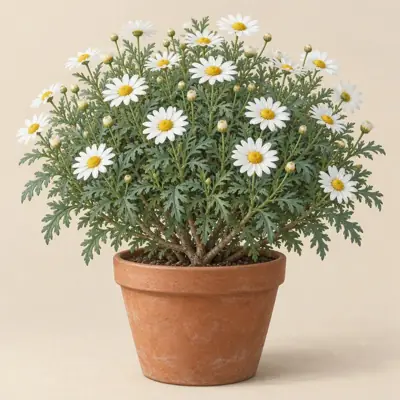
Sources differ on mature size, with the limited evidence suggesting a height of about 50–100 cm; spread is reported from few sources at about 50–100 cm. The alternate leaves are green to blue-green and may be slightly succulent, with ovate to ovate-lanceolate outlines that are often deeply lobed or pinnately divided; the foliage is described as evergreen. The flower heads are daisy-like, typically with white ray florets around yellow disc florets, while cultivated forms may also have yellow, pink, red or purple flowers and single or double forms; sources differ in their descriptions. Flowering varies with climate and growing conditions, and sources differ on its timing; the fruit is reported to be an achene, with fertile winged achenes from the outer white ray florets and sterile, single-winged achenes from the yellow central disc florets, with an irregular crown-like pappus.
Light
Argyranthemum frutescens prefers full sun and ample sunlight.
Watering
The growing medium should drain well and should not remain excessively waterlogged; the plant tolerates some drought, and Taiwan sources favor relatively dry conditions.
Humidity and airflow
Argyranthemum frutescens prefers low humidity and is reported to need good airflow.
Temperature and dormancy
The stated minimum temperature is 0 °C. Few sources report an ideal temperature range of about 20–28 °C.
Growing medium and mounting
It prefers well-drained soil and may be grown in loamy or sandy soil; Taiwan agricultural sources favor sandy loam, while other descriptions include moderately fertile soil as well as the well-drained, poor soils of its native habitat.
Feeding
Taiwan agricultural information reports that the plant should be fertilized periodically.
Propagation
Propagation is mainly by cuttings, using shoot-tip, softwood or non-flowering semi-ripe cuttings depending on the source; some sources also report propagation from seed.
Common problems
Potential pests include aphids, noctuid larvae and leaf miners. Japanese sources associate repeated cultivation and sustained high temperatures with damping-off, while the RHS lists crown gall as a possible problem. Waterlogging may kill the plant, container-grown plants can become root-bound, severe pruning that leaves branches without healthy foliage may cause dieback, and hot, humid conditions can impair growth and increase disease problems. The plant is sensitive to frost and below-freezing temperatures, and hot, humid conditions are also unfavorable; sources differ on wind tolerance, describing both tolerance of sea winds and a need for wind protection.
Identification
Argyranthemum frutescens is strongly branched and can form a rounded clump, with deeply divided leaves, daisy-like flower heads bearing white ray florets around a yellow central disc, and stems that may become woody with age.
Photos


Sources
- Wikipedia (en): Argyranthemum frutescens — CC BY-SA 4.0 · link
- 維基百科:木茼蒿 — CC BY-SA 4.0 · link
- Wikipedia (ja): マーガレット (植物) — CC BY-SA 4.0 · link
- Wikipedia (de): Strauchmargerite — CC BY-SA 4.0 · link
- Wikipedia (fr): Argyranthemum frutescens — CC BY-SA 4.0 · link
- Wikipedia (es): Argyranthemum frutescens — CC BY-SA 4.0 · link
- GBIF descriptions: Manual of the Alien Plants of Belgium; Lista de especies de plantas exóticas y trasplantadas de Colo — per dataset · link
- TaiCOL 臺灣物種名錄: Argyranthemum frutescens — CC BY 4.0 · link
- 農業知識入口網 植物圖鑑: Argyranthemum frutescens — © MOA, facts only · link
- RHS Plants: Argyranthemum frutescens — © RHS, facts only · link
- USDA PLANTS Database: Argyranthemum frutescens — Public domain (US Government work) · link