
garden asparagus (Asparagus officinalis)
Asparagus officinalis is a perennial herbaceous plant.
Overview
Asparagus officinalis is a perennial herbaceous plant.
Origin and habitat
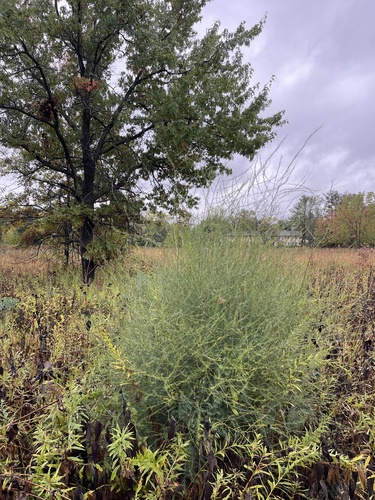
Its native range includes Europe, North Africa, and areas from Western to Central Asia; sources differ on whether the range extends farther east. It occurs in fertile sandy soils along coasts or riverbanks, as well as in grasslands, riparian scrub, deciduous and mixed forests, rocky areas, agricultural land, gardens, and other human-modified environments. It is reported to be primarily adapted to temperate environments and can also be cultivated at higher elevations in tropical areas, favoring climates with warmer days, cooler nights, and a cold dormancy period.
Characteristics
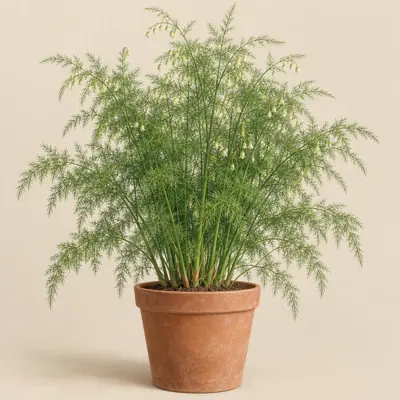
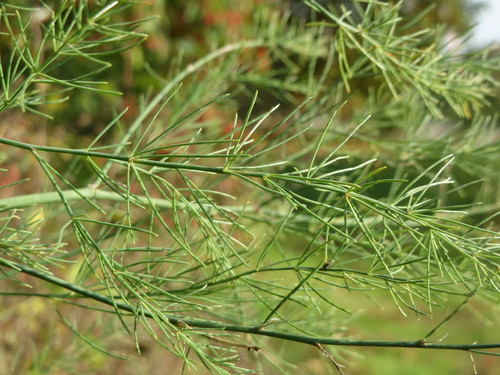
Sources differ, placing mature height at about 100–150 cm and mature spread at about 45.72–91.44 cm. The true leaves are reduced to scales, while the fine, needle-like, feathery structures are mainly green, photosynthetic modified stems that may occur in clusters. The small, bell-shaped flowers range from greenish white and yellowish white to pale yellow, may occur singly or in clusters, and plants are usually of separate sexes, with bisexual flowers occurring occasionally. Flowering occurs during a limited part of the year, and the mature fruit is a red to scarlet berry.
Light
It prefers full sun.
Watering
Keep the soil moist but well drained, watering regularly and moderately after the surface soil has dried slightly.
Temperature and dormancy
Sources differ on the lower temperature limit, with limited evidence placing it at about -15 °C. A single source reports an ideal range of about 15–30 °C and an upper limit of about 38 °C; sources are few. It is generally reported to be frost hardy and to have a defined USDA hardiness-zone range.
Growing medium and mounting
It prefers fertile, organic-rich, well-drained sandy loam and can grow in sandy, loamy, clay, or chalky soils; sources differ on the reported breadth of its soil pH tolerance.
Propagation
It can be propagated from seed and also has underground rhizomes through which the plant can continue growing.
Common problems
It is reported to be susceptible to insect pests associated with asparagus. It is reported to have allelopathic effects, and repeated cultivation in the same ground may cause problems. Dormant plants are reported to tolerate substantially colder conditions than tender new shoots, which may suffer severe cold damage at temperatures only slightly below freezing.
Identification
The plant has an underground crown formed by rhizomes and fleshy roots; emerging shoots develop into upright, highly branched stems bearing fine, needle-like, feathery-looking modified stems. Male and female plants are usually separate.
Photos


Sources
- Wikipedia (en): Asparagus — CC BY-SA 4.0 · link
- 維基百科:芦笋 — CC BY-SA 4.0 · link
- Wikipedia (ja): アスパラガス — CC BY-SA 4.0 · link
- Wikipedia (de): Gemüsespargel — CC BY-SA 4.0 · link
- Wikipedia (fr): Asperge — CC BY-SA 4.0 · link
- Wikipedia (es): Asparagus officinalis — CC BY-SA 4.0 · link
- GBIF descriptions: Checklist of introduced taxa in Cyprus; Database of Vascular Plants of Canada (VASCAN); Nordic crop — per dataset · link
- NC State Plant Toolbox: Asparagus officinalis — copyright (facts only) · link
- Wikipedia (it): Asparagus officinalis — CC BY-SA 4.0 · link
- Wikipedia (pt): Asparagus officinalis — CC BY-SA 4.0 · link
- Useful Tropical/Temperate Plants: Asparagus officinalis — CC BY-NC-SA 3.0 (facts only) · link
- RHS Plants: Asparagus officinalis — © RHS, facts only · link
- USDA PLANTS Database: Asparagus officinalis — Public domain (US Government work) · link
- Top Tropicals catalog: Asparagus officinalis — © Top Tropicals LLC (facts only) · link