
sanddollar (Astrophytum asterias)
Astrophytum asterias is a small, solitary, spineless perennial cactus with a flattened globular to disc-like, globular growth form.
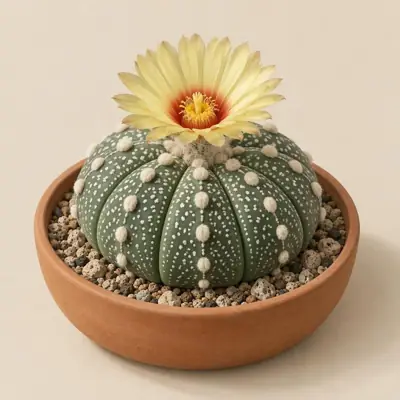
Overview
Astrophytum asterias is a small, solitary, spineless perennial cactus with a flattened globular to disc-like, globular growth form.
Origin and habitat
It is native to southern Texas in the United States around the lower Rio Grande, and to Tamaulipas and Nuevo León in northeastern Mexico; its remaining wild distribution is greatly reduced, and the Nuevo León population may be regionally extinct. It occurs in dry thorn scrub, grassland, and rocky or gravelly places, including hills, depressions, and beside dry riverbeds, on substrates that include gravelly alluvial loam and saline or calcareous clay. Plants are often shaded by other vegetation or rocks and may be largely buried in soil and sand. Its habitat has a warm-temperate to subtropical, semi-desert, dry or semi-arid climate.
Characteristics
Sources differ on mature size, giving a height of about 2.5–6 cm and a spread of about 5–15 cm. It is reported to grow slowly. Flowers are borne at the top of the plant and are yellow with red at the base or throat; the exterior may be conspicuously hairy. Sources differ in their descriptions of flowering time, while the fruit is described differently as well; it is oval, green to pink, and covered with soft hairs.
Light
Astrophytum asterias takes full sun, and cultivation information indicates that ample sunlight supports continued flowering.
Watering
It requires little water; watering can be somewhat greater during the growing season than in winter, but the medium should dry between waterings, remain very dry in winter, and not become waterlogged.
Humidity and airflow
It is reported to prefer low humidity.
Temperature and dormancy
A single source reports a lower temperature around -6 °C; it also describes the plant as tolerating brief light frost and as frost hardy. It is generally reported to have an upper temperature limit and a USDA hardiness-zone classification. It rests cool and dry in winter.
Growing medium and mounting
Sources differ, but the growing medium is described as alkaline, porous, and well drained.
Feeding
A single source reports that half-strength liquid fertilizer can be used after flower buds form.
Propagation
Propagation is mainly by seed, which can germinate quickly; some cultivated varieties are also propagated by grafting or vegetatively.
Common problems
Root rot is reported as a disease problem. Wild populations are threatened mainly by habitat destruction and excessive illegal collection; urban development, agriculture, road construction, herbicides, and scrub removal are also listed as causes of decline. It prefers dry conditions and should remain dry in cool periods.
Identification
Sources differ in their descriptions, but the plant is flattened-globular and spineless, usually with low ribs arranged in a star pattern; the ribs bear large white woolly areoles, while the epidermis often has white scaly flecks, producing a regular star-like appearance from above.
Photos


Sources
- Wikipedia (en): Astrophytum asterias — CC BY-SA 4.0 · link
- 維基百科:星紅仙人球 — CC BY-SA 4.0 · link
- Wikipedia (de): Astrophytum asterias — CC BY-SA 4.0 · link
- Wikipedia (fr): Astrophytum asterias — CC BY-SA 4.0 · link
- Wikipedia (es): Astrophytum asterias — CC BY-SA 4.0 · link
- Wikipedia (nl): Astrophytum asterias — CC BY-SA 4.0 · link
- LLIFLE Encyclopedia of living forms: Astrophytum asterias — CC BY-SA · link
- USDA PLANTS Database: Astrophytum asterias — Public domain (US Government work) · link
- Desert-Tropicals: Astrophytum asterias — © Philippe Faucon (desert-tropicals.com), facts only · link
- The Succulent Plant Page: Astrophytum (genus-level) — © R.J. Hodgkiss, facts only · link
- NC State Plant Toolbox: Astrophytum (genus-level) — copyright (facts only) · link
- PUKUBOOK: Astrophytum asterias — CC BY-NC (facts only) · link
- Astrophytum asterias | Giromagi cactus and succulents for sale | Buy plants onli (www.giromagi.com) — facts only (§12) · link