
carambola (Averrhoa carambola)
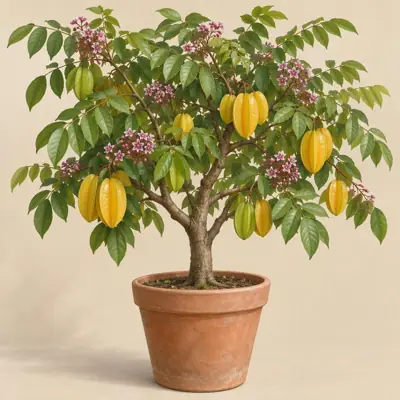
Averrhoa carambola is a perennial evergreen woody plant that grows as a small tree or shrub, typically with many branches and a short trunk.
Overview
Averrhoa carambola is a perennial evergreen woody plant that grows as a small tree or shrub, typically with many branches and a short trunk.
Origin and habitat
Sources differ in describing its native range within tropical Asia, centered on Southeast Asia, with some accounts additionally naming parts of South Asia and Indonesia. It occurs in moist forests and woodlands and can grow in sandy loam across a recorded range of elevations. It is suited to hot, humid tropical climates and can also be cultivated in some subtropical regions.
Characteristics
Sources differ on mature height, reporting it at about 300–1500 cm. Sources differ in describing the growth rate as slow to moderate. The leaves are reported to be compound, alternate or spirally arranged, soft and medium green, with ovate to oblong leaflets that respond to light and touch. The small flowers have petals and range from red to reddish purple or reddish white, often forming inflorescences in leaf axils or on branches; in tropical conditions, flowering is reported to occur year-round and may recur during the year, while the juicy fruit has prominent longitudinal ribs, changes from green to shades of yellow or yellow-orange as it matures, and is star-shaped in cross-section.
Light
It can be grown in full sun or bright light and can accept partial shade; some sources favor a somewhat shaded position.
Watering
Water regularly after allowing the surface soil to dry slightly; the soil should drain well because the plant does not tolerate waterlogging.
Humidity and airflow
It is reported to prefer high humidity and needs little air movement.
Temperature and dormancy
Sources differ, with limited information indicating a minimum temperature of about 5 °C. A limited source reports an ideal temperature range of about 24–30 °C and a maximum of about 39 °C. A USDA hardiness classification is reported, and the plant tolerates brief light frost.
Growing medium and mounting
It is reported to prefer well-drained, slightly acidic soil, does not tolerate waterlogging, and can adapt to various soil types.
Propagation
It is reported to be propagated from seed, by layering, and by grafting.
Common problems
The plant does not tolerate waterlogging, while low temperatures can damage new growth or young plants, and strong winds are unfavorable. It is sensitive to frost and low temperatures, especially when young; mature plants can withstand brief light frost but may be killed by sufficiently severe cold, and strong winds should be avoided.
Identification
Its most distinctive feature is the fruit with prominent longitudinal ribs, typically forming a star shape in cross-section.
Photos


Sources
- GBIF Backbone: Averrhoa carambola L. — CC BY 4.0 · link
- Wikipedia (en): Averrhoa carambola — CC BY-SA 4.0 · link
- 維基百科:楊桃 — CC BY-SA 4.0 · link
- Wikipedia (ja): スターフルーツ — CC BY-SA 4.0 · link
- Wikipedia (de): Sternfrucht — CC BY-SA 4.0 · link
- Wikipedia (fr): Carambolier — CC BY-SA 4.0 · link
- Wikipedia (es): Averrhoa carambola — CC BY-SA 4.0 · link
- GBIF descriptions: The checklist of alien seed plants of D.R. Congo, based on evidence from herbarium collections; Espe — per dataset · link
- Wikipedia (it): Averrhoa carambola — CC BY-SA 4.0 · link
- Wikipedia (nl): Carambola — CC BY-SA 4.0 · link
- Wikipedia (pt): Averrhoa carambola — CC BY-SA 4.0 · link
- Useful Tropical/Temperate Plants: Averrhoa carambola — CC BY-NC-SA 3.0 (facts only) · link
- USDA PLANTS Database: Averrhoa carambola — Public domain (US Government work) · link
- Top Tropicals catalog: Averrhoa carambola — © Top Tropicals LLC (facts only) · link