
Iron Cross Begonia (Begonia masoniana)
Begonia masoniana is a rhizomatous, clump-forming herbaceous foliage plant. Sources differ in describing it as an evergreen perennial herb.
Overview
Begonia masoniana is a rhizomatous, clump-forming herbaceous foliage plant. Sources differ in describing it as an evergreen perennial herb.
Origin and habitat
Sources differ on its native range, which is described as China and Vietnam, with records of wild occurrence in Guangxi, China. It is reported from moist soil hollows in dense forest, limestone on hillsides, and beneath shrubs beside hillside gullies in Guangxi. It is frost-sensitive and suited to warm, frost-free conditions; in temperate regions it requires frost-free cultivation such as in a greenhouse or indoors.
Characteristics
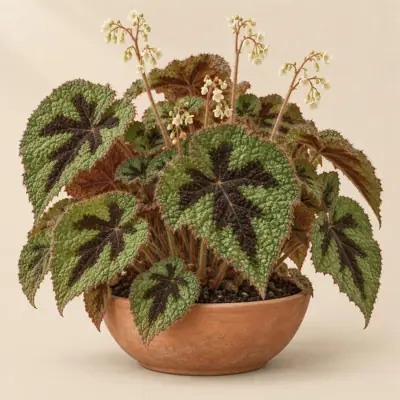
Sources differ on mature height, placing it at about 10–50 cm, while a single source reports a mature spread of about 10–50 cm. The leaves are large, ovate to asymmetrical and green, with a rough or puckered, strongly textured surface, red hairs, and a dark brown cross-shaped marking in the center. The small greenish-white to white flowers are borne in upright panicles, but the plant's ornamental value comes mainly from its foliage rather than its flowers.
Light
Provide bright indirect or filtered light; it can also be grown in partial shade.
Watering
It is reported to prefer evenly moist growing medium during active growth without overwatering; when growth slows, water somewhat less and wait until the surface of the medium is nearly dry before watering again.
Temperature and dormancy
Based on a limited source base, the reported minimum temperature is about 12.8 °C. Based on a limited source base, the reported hardiness range is about zones 11–12.
Growing medium and mounting
Use a moisture-retentive potting medium while avoiding waterlogging; suitable well-drained soils are described as chalky, loamy, or sandy and may be acidic, neutral, or alkaline.
Propagation
Begonia masoniana can be propagated by seed, leaf cuttings, stem cuttings, or sections of rhizome.
Common problems
Potential pests include aphids, mealybugs, mites, thrips, weevils, caterpillars, slugs, and snails. Reported diseases and rot problems include bacterial leaf spot, blight or other rots, stem or crown rot, rhizome rot, gray mold, and powdery mildew. It is reported to be vulnerable to slugs and snails when moved outdoors in summer with the pot placed directly on the ground. It is frost-sensitive, does not tolerate low temperatures, and requires frost-free conditions; outdoor survival is reported to be unsuitable below a cool temperature threshold.
Identification
A conspicuous dark brown cross-shaped marking in the center of the leaf gives it the appearance associated with the name Iron Cross Begonia; it is a rhizomatous begonia.
Photos

