
Painted-leaf Begonia (Begonia rex)
Begonia rex is reported to be a perennial herbaceous plant with rhizomes.
Overview
Begonia rex is reported to be a perennial herbaceous plant with rhizomes.
Origin and habitat
Sources differ on its Asian native range, with accounts including northeastern India and the Himalayan region, as well as southwestern China, Vietnam, Bhutan, and northern Myanmar. Sources differ in describing its natural habitat; it is reported from shaded settings such as forests, valleys, rocky ravines, and caves. It is reported to be native to forest environments in the Himalayas and neighboring parts of Asia, while horticultural cultivation generally favors warm conditions with some humidity.
Characteristics
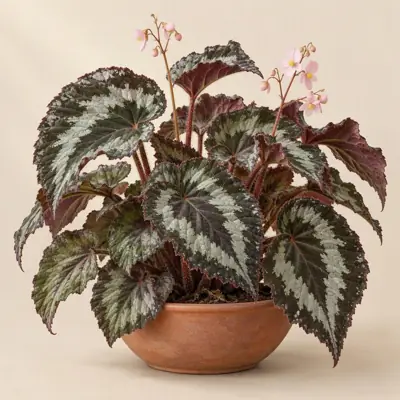
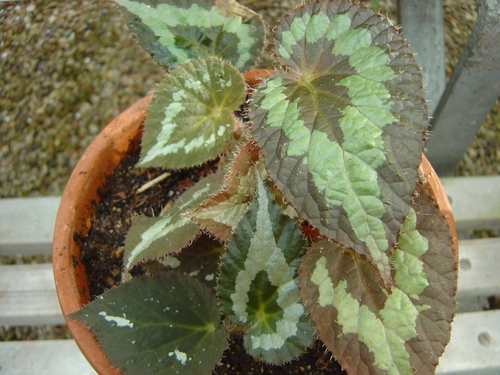
Sources differ, with the limited evidence placing mature height at about 40–40 cm. The leaves are reported to be large, ovate, and asymmetrical, with dark coloration and gray-green or silver markings; the undersides may be green and purple, and the petioles are densely hairy. The flowers are reported to range from pale pink to pink, with male and female flowers differing in their unequal perianth segments. The fruit is reported to be a capsule with unequal wings.
Light
Bright, indirect light is generally suitable, while strong direct sunlight should be avoided because it may scorch the leaves; horticultural guidance also recommends partial shade to shade.
Watering
During growth, water regularly after the surface of the growing medium has dried slightly; the medium should drain well, as overly wet conditions may increase the risk of root rot.
Humidity and airflow
Begonia rex generally prefers moderate humidity.
Temperature and dormancy
Sources differ on the reported hardiness zone. Begonia rex is generally frost tender; keep above freezing.
Growing medium and mounting
A well-drained growing medium is generally suitable; another source recommends a fertilized growing medium mixed with sand.
Feeding
A balanced liquid fertilizer may be used in moderation, and cultivation information also describes the use of a fertile growing medium.
Propagation
Begonia rex is reported to be propagated by leaf cuttings, with cuts made near the main veins from which new plants can form; crowded rhizomes may also be divided when repotting.
Common problems
Thrips and mealybugs are reported as common pests of Begonia. Begonia can develop bacterial leaf spot, while overly wet conditions may increase root rot problems. Strong direct sunlight may scorch the leaves, and overly wet growing medium can present a risk of root rot. Begonia rex is reported to be frost tender and should be protected from freezing in cold regions.
Identification
Begonia rex is reported to be distinguished by its large, asymmetrical foliage with dark, gray-green to silver markings, and in horticulture it is grown mainly for its leaves rather than its flowers.
Photos


Sources
- Wikipedia (en): Begonia rex — CC BY-SA 4.0 · link
- 維基百科:尖蕊秋海棠 — CC BY-SA 4.0 · link
- Wikipedia (fr): Begonia rex — CC BY-SA 4.0 · link
- Wikipedia (es): Begonia rex — CC BY-SA 4.0 · link
- GBIF descriptions: Lista de especies de plantas exóticas y trasplantadas de Colombia; Catálogo de Plantas y Líquenes de — per dataset · link
- Wikipedia (it): Begonia rex — CC BY-SA 4.0 · link
- Top Tropicals catalog: Begonia rex — © Top Tropicals LLC (facts only) · link