
bedding begonia (Begonia semperflorens-cultorum hybrid)
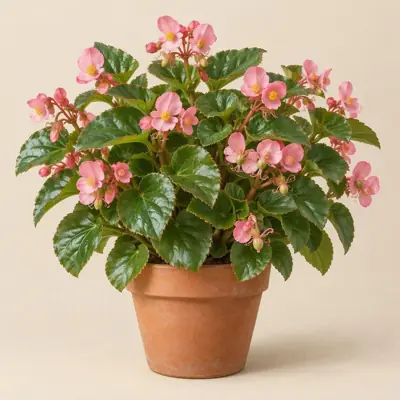
Begonia semperflorens-cultorum is reported to be a small, fibrous-rooted herb, and Semperflorens or wax begonia types are commonly grown as bedding plants; Begonia plants may be upright, clumping, trailing, or spreading. Sources differ: horticulturally, the Semperflorens group is often grown as an annual bedding plant, but it may survive for several years in suitable conditions and when overwintered indoors.
Overview
Begonia semperflorens-cultorum is reported to be a small, fibrous-rooted herb, and Semperflorens or wax begonia types are commonly grown as bedding plants; Begonia plants may be upright, clumping, trailing, or spreading. Sources differ: horticulturally, the Semperflorens group is often grown as an annual bedding plant, but it may survive for several years in suitable conditions and when overwintered indoors.
Origin and habitat
The native range of Begonia is reported to lie mainly in tropical and subtropical regions of Central and South America, Africa, and Asia. Begonia plants are generally found in forest understories; most species are terrestrial, while some may be epiphytes. Begonia is generally adapted to warm tropical and subtropical environments, and most Begonia do not tolerate low temperatures.
Characteristics
Leaves are generally asymmetrical, and Begonia foliage may be green, brown, bronze, or burgundy and may also be patterned. The Semperflorens group is reported to produce many small flowers continuously; Begonia flowers may be single or double and pink, red, orange, yellow, or white, with separate male and female flowers borne on the same plant. Under suitable conditions, flowering may continue for a long period, and the Semperflorens group is known for abundant, continuous flowering. The fruit is generally a winged capsule containing many small seeds.
Light
Bright shade or partial sun is generally suitable, while most Begonia are reported to be unsuited to full sun in hot climates.
Watering
The growing medium should generally remain moist but well drained, without prolonged waterlogging or drying out completely; overwatering is reported to increase the risk of root rot.
Humidity and airflow
Begonia semperflorens-cultorum is reported to prefer high humidity.
Temperature and dormancy
A minimum temperature is reported for Begonia semperflorens-cultorum, but the available claim does not support stating a numerical value. It is generally frost tender; keep above freezing.
Growing medium and mounting
A moist, well-drained medium rich in organic matter and ranging from acidic to neutral is generally suitable.
Propagation
Propagation is reported to be possible by seed, stem cuttings, leaf cuttings, or division, although suitable methods differ among Begonia groups.
Common problems
Reported pests include mealybugs, whiteflies, thrips, scale insects, snails, slugs, and spider mites. Reported diseases include root rot, fungal leaf diseases such as powdery mildew, gray mold, stem rot, and Pythium root and stem rot. Overwatering is reported to encourage root rot, while the leaves and flowers are delicate and should not remain wet for prolonged periods during watering. The plant is reported to be sensitive to low temperatures and strong winds; most cultivated Begonia do not tolerate sufficiently low temperatures, and their delicate leaves and flowers should be protected from strong winds.
Identification
The Semperflorens or wax begonia group is generally characterized by small, fibrous-rooted plants that produce many small flowers continuously and are commonly used as bedding plants.