
Daisy (Bellis perennis)
Bellis perennis is a low-growing herb with leaves forming a rosette close to the ground and solitary flower heads borne on leafless stalks. It is a perennial herb, but in regions with hot summers where it does not readily survive the summer, it is often grown as an annual and may also be managed as a tender biennial.
Overview
Bellis perennis is a low-growing herb with leaves forming a rosette close to the ground and solitary flower heads borne on leafless stalks. It is a perennial herb, but in regions with hot summers where it does not readily survive the summer, it is often grown as an annual and may also be managed as a tender biennial.
Origin and habitat
Sources differ on its native range; Europe is given as its native range. It is commonly found in lawns, grasslands, pastures, and other low-growing herbaceous habitats, and can also occur in managed environments such as parks and gardens. It is suited to cooler temperate conditions and may decline or fail to survive the summer in hotter regions.
Characteristics
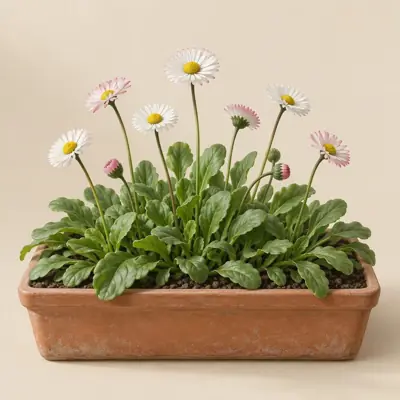
Sources differ on mature height, with reports ranging about 2–20 cm. A single source reports a mature spread of about 0–10 cm. Growth is slower initially and becomes faster after establishment; under suitable conditions it can expand into weed-like populations. The basal leaves form a ground-hugging rosette and are generally round, spoon-shaped to obovate-spoon-shaped, with finely toothed or rounded-toothed margins; some sources describe them as slightly hairy. The flower heads are generally solitary, with mainly white outer ray florets that may be tinged pink or red around yellow central disc florets; cultivated forms may be red, white, pink, or multicolored and include semi-double and double forms. Sources differ on flowering season: flowering is mainly from spring to summer but may extend from late winter or spring into autumn, with some flowering possible even in winter in mild climates. A single source reports that the fruit is an obovate, flattened achene without a pappus.
Light
It grows in full sun to partial shade, with afternoon shade suitable in hotter conditions.
Watering
It prefers moist but well-drained soil and does not tolerate drought.
Temperature and dormancy
It is reported by a single source as having an RHS hardiness rating of H7.
Growing medium and mounting
It adapts to clay, loam, sand, and calcareous soils, while preferring fertile, moist but well-drained growing media; sources support acidic, neutral, and alkaline conditions.
Feeding
It is reported to prefer relatively fertile soil.
Propagation
It can be propagated by seed or division; division can be used in colder regions where plants survive the summer.
Common problems
Aphids are reported to occur from spring through autumn, sucking sap from new shoots, stems, young leaves, and leaf undersides and weakening the plant. Hot summers may cause decline or prevent plants from surviving the summer, while under suitable conditions they may spread rapidly into lawns and become difficult-to-control weeds. It does not tolerate summer heat or drought and prefers cool conditions.
Identification
Key identifying features are ground-hugging rosettes of spoon-shaped leaves, leafless flower stalks, and white to pink- or red-tinged outer ray florets surrounding yellow central disc florets; each flower head is a composite structure made up of many small florets.
Photos


Sources
- Wikipedia (en): Bellis perennis — CC BY-SA 4.0 · link
- 維基百科:雛菊 — CC BY-SA 4.0 · link
- Wikipedia (ja): ヒナギク — CC BY-SA 4.0 · link
- Wikipedia (de): Gänseblümchen — CC BY-SA 4.0 · link
- Wikipedia (es): Bellis perennis — CC BY-SA 4.0 · link
- GBIF descriptions: Database of Vascular Plants of Canada (VASCAN); Catálogo de Plantas y Líquenes de Colombia; DAISIE - — per dataset · link
- NC State Plant Toolbox: Bellis perennis — copyright (facts only) · link
- TaiCOL 臺灣物種名錄: Bellis perennis — CC BY 4.0 · link
- Useful Tropical/Temperate Plants: Bellis perennis — CC BY-NC-SA 3.0 (facts only) · link
- RHS Plants: Bellis perennis — © RHS, facts only · link
- USDA PLANTS Database: Bellis perennis — Public domain (US Government work) · link