
common beet (Beta vulgaris)
Beta vulgaris is an upright or clump-forming herb that commonly forms a basal rosette, and cultivated forms may develop thick, fleshy roots. Sources differ on its life cycle: it is mainly biennial, with some accounts also describing annual or perennial forms, while cultivated forms are mostly biennial.
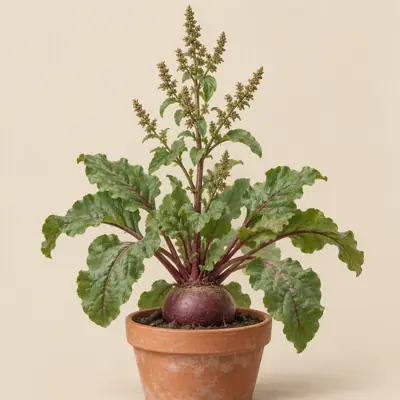
Overview
Beta vulgaris is an upright or clump-forming herb that commonly forms a basal rosette, and cultivated forms may develop thick, fleshy roots. Sources differ on its life cycle: it is mainly biennial, with some accounts also describing annual or perennial forms, while cultivated forms are mostly biennial.
Origin and habitat
Sources differ on the native range, which is described as mainly spanning Europe and the Mediterranean coast and extending into western Asia, the Near East, North Africa, and the Indian subcontinent; the wild ancestor Beta vulgaris subsp. maritima is described from the Atlantic and Mediterranean coasts of Europe, the Near East, and India. It occurs in coastal zones, seasonally wet grassland, and agricultural or horticultural settings; in cultivation it suits moist, well-drained soil and can also adapt to coastal environments. It is chiefly associated with temperate, relatively cool climates, and cultivation in tropical regions generally requires higher elevations.
Characteristics
Sources differ on mature height, placing it at about 20–200 cm; mature spread is reported from few sources at about 10–50 cm. The leaves are reported to be simple and stalked; basal leaves range from oblanceolate or oblong to heart-shaped, from green to dark red, and are slightly fleshy with entire or wavy margins and often a conspicuous midrib, while cultivated forms generally have larger leaves than wild forms and upper stem leaves are smaller and may range from diamond-shaped to narrowly lanceolate. The very small flowers are green to slightly reddish, have tepals, and occur in dense spike-like inflorescences; they are bisexual and are mainly wind-pollinated, with insect pollination also recorded. Flowering is reported from June through September, and the fruit is reported to be a small, single-seeded fruit whose neighboring perianth bases may harden together at maturity into a hard aggregated fruit cluster; the seeds are lentil-shaped with glossy reddish-brown seed coats.
Light
Beta vulgaris grows in full sun to partial sun, and good light supports growth.
Watering
Keep the soil moist but well drained, avoiding prolonged waterlogging.
Temperature and dormancy
The ideal temperature range is 15–25 °C. Few sources report a lower temperature around 4 °C and an upper temperature around 35 °C.
Growing medium and mounting
It can grow in chalk, clay, loam, and sand, while preferring deep, loose, fertile, well-drained soil and adapting to acidic, neutral, or alkaline conditions.
Propagation
Propagation is generally reported to be by seed.
Common problems
Pigeons, slugs, and snails are reported to cause damage. Botrytis and downy mildew are reported to occur. Hot, humid conditions are reported to reduce sugar content and hinder sugar accumulation. Young tissues are relatively sensitive to low temperatures, which can cause severe damage.
Identification
Cultivated forms are highly variable and may develop thick, fleshy roots or thickened leaf stalks depending on their use; roots may be dark red, purple, white, yellow, or red-and-white striped, while leaves range from green to dark red.
Photos



Sources
- Wikipedia (en): Beta vulgaris — CC BY-SA 4.0 · link
- 維基百科:甜菜 — CC BY-SA 4.0 · link
- Wikipedia (ja): ビート (植物) — CC BY-SA 4.0 · link
- Wikipedia (de): Rübe (Art) — CC BY-SA 4.0 · link
- Wikipedia (fr): Beta vulgaris — CC BY-SA 4.0 · link
- Wikipedia (es): Beta vulgaris — CC BY-SA 4.0 · link
- GBIF descriptions: Checklist of introduced taxa in Romania; Nordic crop wild relative priority list; Catálogo de Planta — per dataset · link
- TaiCOL 臺灣物種名錄: Beta vulgaris — CC BY 4.0 · link
- Useful Tropical/Temperate Plants: Beta vulgaris — CC BY-NC-SA 3.0 (facts only) · link
- RHS Plants: Beta vulgaris — © RHS, facts only · link
- USDA PLANTS Database: Beta vulgaris — Public domain (US Government work) · link