
Queen's-Tears (Billbergia nutans)
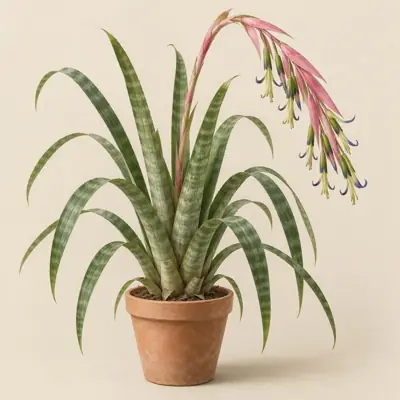
Billbergia nutans is an evergreen, clump-forming perennial that forms funnel-shaped rosettes and can grow as an epiphyte.
Overview
Billbergia nutans is an evergreen, clump-forming perennial that forms funnel-shaped rosettes and can grow as an epiphyte.
Origin and habitat
It is native to South America, principally southern to southeastern Brazil, Paraguay, Uruguay, and northern Argentina. It is reported to grow epiphytically and on rocks, with records from elevated sites in Brazil. Horticultural cultivation information indicates that it can be grown outdoors in frost-free or subtropical conditions and is also commonly grown in greenhouses and indoors.
Characteristics
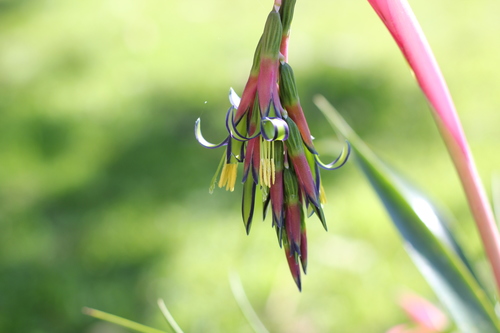
Sources differ on mature height, placing it at about 30–50 cm, while the few sources for mature spread report about 10–50 cm. The linear to strap-shaped leaves arch downward in rosettes, have long pointed tips and very finely toothed margins, and are described as dark green above with dense whitish powdery scales beneath; other sources describe gray-green or olive-green foliage with silvery and red tones. The slender flower stalk gradually bends downward, bearing nodding flowers near its tip, with pink lance-shaped bracts and yellow-green petals edged blue-purple that curl back when open; other sources describe a pink floral tube, purple margins, and green perianth segments. Flowering occurs from winter to spring, and the plant is generally reported to have silvery, dense trichomes.
Light
Billbergia nutans suits bright indirect light to partial sun; from spring through autumn, increased sun can help maintain compact growth and leaf color, while shade is appropriate under hot, dry, or poorly ventilated conditions to avoid leaf scorch.
Watering
During the growing season, it can be watered thoroughly from above so that old water in the central tank is replaced with fresh water, and the central tank can be filled; winter cultivation guidance cited in the claim advises against leaving water continuously in the tank, while the growing medium should drain well.
Humidity and airflow
It is generally reported to prefer high humidity and needs good airflow.
Temperature and dormancy
Sources differ on the lower temperature limit, with the limited available information placing it at about -5 °C. USDA and RHS hardiness classifications are reported for the species. It is generally reported to be frost hardy.
Growing medium and mounting
Use a well-drained, well-aerated medium; sources describe loamy or sandy, acidic to neutral soil, epiphytic bromeliad mixes, or freely draining media of the kind used for orchids or succulents. It can be mounted, grown in a basket or potted.
Feeding
A source reports using diluted, balanced liquid fertilizer during the indicated feeding period; excessive fertilizer may cause elongated growth and poorer leaf color, and feeding can be stopped if growth has already become elongated.
Propagation
It can be propagated from seed or by separating offsets; offsets can be cut from the stem after they have developed several leaves and planted into a medium such as sphagnum moss.
Common problems
Scale insects can occur, particularly with poor airflow, while diseases are generally reported to be relatively uncommon. A source reports that poor airflow combined with dry conditions can lead to leaf scorch, while insufficient light or excessive fertilizer can produce elongated growth and poorer leaf color. Hot, dry conditions can cause leaf scorch, and sources differ on cold tolerance, with some advising avoidance of frost while others report brief tolerance of subzero temperatures.
Identification
Distinctive features include clumps of slender, funnel-shaped leaf rosettes with conspicuously drooping inflorescences, together with long pink bracts surrounding green to yellow-green perianth parts edged in blue-purple or purple that curl back.
Photos


Sources
- Wikipedia (en): Billbergia nutans — CC BY-SA 4.0 · link
- 維基百科:垂花水塔花 — CC BY-SA 4.0 · link
- Wikipedia (ja): ヨウラクツツアナナス — CC BY-SA 4.0 · link
- Wikipedia (fr): Billbergia nutans — CC BY-SA 4.0 · link
- Wikipedia (es): Billbergia nutans — CC BY-SA 4.0 · link
- RHS Plants: Billbergia nutans — © RHS, facts only · link
- NHK みんなの趣味の園芸 植物図鑑: Billbergia nutans — © NHK出版, facts only · link
- Top Tropicals catalog: Billbergia nutans — © Top Tropicals LLC (facts only) · link