
Bismarck Palm (Bismarckia nobilis)
Bismarckia nobilis is reported to be a large, evergreen, tree-like, single-trunked fan palm with separate male and female plants.
Overview
Bismarckia nobilis is reported to be a large, evergreen, tree-like, single-trunked fan palm with separate male and female plants.
Origin and habitat
Bismarckia nobilis is endemic to Madagascar, occurring mainly in western and northern areas and the central highlands. Sources differ in their habitat descriptions, which include open grassland, low-grass savanna, and drier or open woodland environments, with lateritic soils common in its native habitat. It is native to drier environments in Madagascar and is widely cultivated in tropical, subtropical, and warm-temperate regions.
Characteristics
Mature plants reach 1200–2500 cm in height. A single source reports a mature spread of about 750–750 cm, so sources are few. Sources differ in describing the large, nearly circular palmate to costapalmate fan leaves, which are deeply divided into stiff segments and have a waxy surface that is often silvery white, gray-green, or gray-blue. Male and female flowers are reported to occur on separate plants; the small flowers are borne in inflorescences among the leaves, and male and female inflorescences are similar in appearance.
Light
Bismarckia nobilis grows in full sun.
Watering
Established plants have some drought tolerance, while young plants benefit from regular watering during their initial years after establishment; growth can continue under drier conditions but is slower.
Temperature and dormancy
Sources differ on minimum temperature tolerance; the limited evidence places it at about -1 °C.
Growing medium and mounting
Well-drained soil is preferred; Bismarckia nobilis can adapt to acidic or alkaline soils and can also grow in clay, while lateritic soils are common in its native environment.
Common problems
Bismarckia nobilis is generally reported to have good disease tolerance. Its large crown requires ample planting space, and falling large brown fruits can create cleanup issues. It is sensitive to cold and frost; established plants can withstand very light frost, while stronger frost can scorch the leaves, and green-leaved forms are reported to be more susceptible to cold damage than silvery-gray forms.
Identification
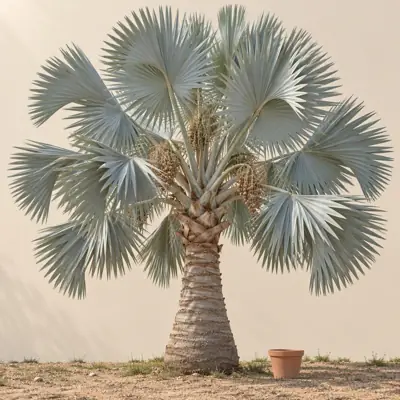
Bismarckia nobilis has a very large, regular crown with conspicuous silvery-white to gray-blue waxy fan leaves, along with a stout single trunk that is gray to yellowish brown, bears ring-like leaf scars, and is slightly swollen at the base.
Photos


Sources
- Wikipedia (en): Bismarckia nobilis — CC BY-SA 4.0 · link
- Wikipedia (ja): ビスマルクヤシ — CC BY-SA 4.0 · link
- Wikipedia (de): Bismarckpalme — CC BY-SA 4.0 · link
- Wikipedia (fr): Bismarckia nobilis — CC BY-SA 4.0 · link
- Wikipedia (es): Bismarckia nobilis — CC BY-SA 4.0 · link
- GBIF descriptions: Lista de especies de plantas exóticas y trasplantadas de Colombia; Catálogo de Plantas y Líquenes de — per dataset · link
- NC State Plant Toolbox: Bismarckia nobilis — copyright (facts only) · link