
Chinese ground orchid (Bletilla striata)
Bletilla striata is a terrestrial herbaceous orchid with flattened or compressed underground pseudobulbs and commonly forms clumps. It is perennial and deciduous.
Overview
Bletilla striata is a terrestrial herbaceous orchid with flattened or compressed underground pseudobulbs and commonly forms clumps. It is perennial and deciduous.
Origin and habitat
Its native range extends from East Asia toward Myanmar, principally including China, Japan, Korea, and Myanmar, with Tibet also listed by some sources; sources differ over whether Taiwan belongs within the native range of Bletilla striata because of taxonomic identification issues. Habitats include grassy slopes, hillside grasslands, grass in sandy soils, evergreen broadleaf forests, oak forests, coniferous forests, and rock crevices. Sources describe it from cooler hillsides in China and grassy slopes in Japan, while horticultural information indicates adaptation to temperate winters with dormancy.
Characteristics
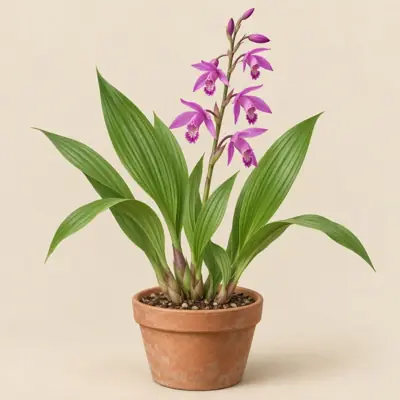
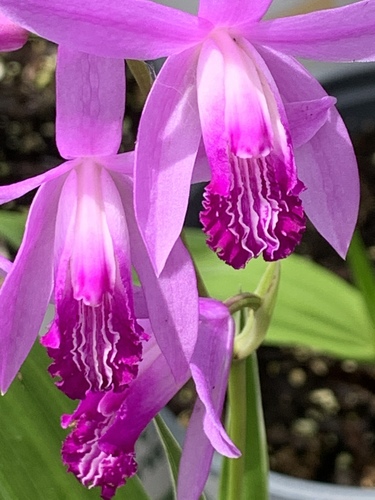
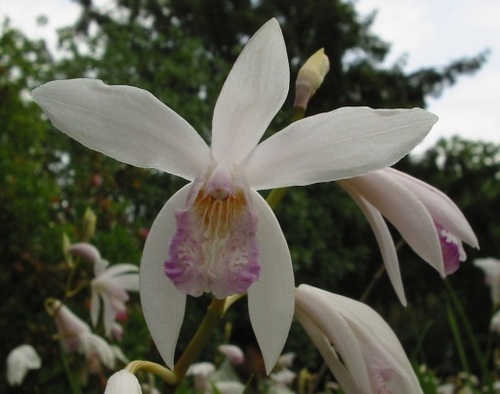
Sources differ on mature height, giving a range of about 18–70 cm, while few sources give a mature spread of about 10–50 cm. Its underground storage organs increase over time so that plants can gradually form clumps, and roots grow relatively quickly in containers. The leaves have conspicuous longitudinal pleats or ridges, range from linear to lance-shaped or oblong, and are often arranged in a fan; sources also describe several leaves per plant. The orchid-like flowers are usually reddish purple, magenta-pink to purple, with white also occurring in cultivated forms; several flowers are borne on an upright inflorescence, flowering is mainly from spring to early summer and may extend into summer under different climates or growing conditions, and fruit may be produced afterward with tiny, powder-like seeds reported to mature and disperse from late autumn into winter.
Light
Medium light is suitable, with bright, partly sunny to partly shaded, sheltered positions and bright indirect light described as appropriate; sources differ, with some also indicating that full sun can be tolerated in humus-rich soil.
Watering
During active growth, provide regular moisture and keep evenly moist while maintaining good drainage and avoiding prolonged waterlogging; after winter dormancy, watering can be greatly reduced, with greenhouse guidance recommending drier winter conditions.
Temperature and dormancy
Few sources report a minimum temperature of about -10 °C. Sources differ on hardiness-zone recommendations and generally indicate that protection may be needed at the colder end in winter. It is reported to be frost hardy and, based on a specialist single source, cool-growing.
Growing medium and mounting
Bletilla striata is terrestrial, has tuberous roots, and prefers a terrestrial mix. Use a well-drained medium that retains moderate moisture, such as humus-rich soil, soil containing leaf mold, or a loose granular medium, while avoiding waterlogging.
Feeding
Fertilizer can be applied during active growth, but sources differ between regular liquid feeding combined with slow-release fertilizer and regular applications of diluted balanced liquid fertilizer.
Propagation
Propagation can be by division or separation of storage organs; sources differ on whether division is preferable in autumn or early spring, and seed propagation is also possible but less commonly used.
Common problems
Slugs, snails, and aphids may cause damage, while greenhouse plants may also encounter spider mites, whiteflies, and mealybugs. Disease is generally uncommon, although sources differ regarding occasional suspected viral problems associated with black, sooty-looking leaf marks or uneven coloration. Poor drainage or overly wet soil is unsuitable, strong sunlight may scorch leaf tips, and slugs or aphids may damage flower buds and flowers. In extremely cold winters, protection with organic mulch or relocation to a frost-free place may be needed; a sheltered position is preferred, and excessively strong midday or western sun should be avoided in summer.
Identification
Bletilla striata has flattened or compressed underground pseudobulbs and conspicuously pleated leaves with longitudinal ribs; new shoots emerge in spring and develop upright inflorescences, and the epithet striata is associated with striped or longitudinally ribbed features.
Photos


Sources
- Wikipedia (en): Bletilla striata — CC BY-SA 4.0 · link
- 維基百科:白芨 — CC BY-SA 4.0 · link
- Wikipedia (ja): シラン (植物) — CC BY-SA 4.0 · link
- Wikipedia (fr): Orchidée jacinthe — CC BY-SA 4.0 · link
- Wikipedia (es): Bletilla striata — CC BY-SA 4.0 · link
- NC State Plant Toolbox: Bletilla striata — copyright (facts only) · link
- TaiCOL 臺灣物種名錄: Bletilla striata — CC BY 4.0 · link
- Useful Tropical/Temperate Plants: Bletilla striata — CC BY-NC-SA 3.0 (facts only) · link
- RHS Plants: Bletilla striata — © RHS, facts only · link
- USDA PLANTS Database: Bletilla striata — Public domain (US Government work) · link
- Internet Orchid Species Photo Encyclopedia: Bletilla striata — © Jay Pfahl / IOSPE contributors, facts only · link
- NHK みんなの趣味の園芸 植物図鑑: Bletilla striata — © NHK出版, facts only · link
- Top Tropicals catalog: Bletilla striata — © Top Tropicals LLC (facts only) · link
- Bletilla striata hyacinth orchid - Havlis.cz (www.havlis.cz) — facts only (§12) · link