
frankincense (Boswellia sacra)
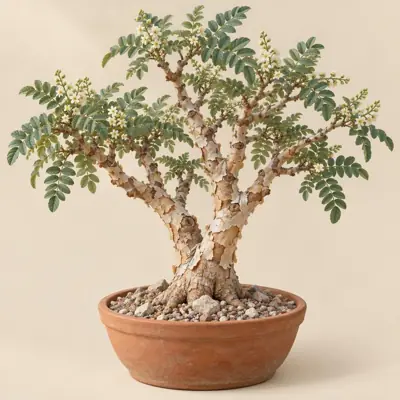
Sources differ in describing Boswellia sacra as a small woody tree with one or more trunks, sometimes with a swollen, tuber-like base or supporting structures. It is a perennial woody plant; sources differ, but most describe it as deciduous, shedding its leaves during the dry season.
Overview
Sources differ in describing Boswellia sacra as a small woody tree with one or more trunks, sometimes with a swollen, tuber-like base or supporting structures. It is a perennial woody plant; sources differ, but most describe it as deciduous, shedding its leaves during the dry season.
Origin and habitat
Sources agree on a native range in the southern Arabian Peninsula and the Horn of Africa, including Oman, Yemen, and Somalia, while some also include Ethiopia and Djibouti. It occurs in arid woodland, dry mountains, steep rocky slopes, eroded slopes, and gullies, often on calcareous soils, and also in fog-oasis woodland in the coastal mountains of the southern Arabian Peninsula. It is adapted to arid to semi-arid environments, including dry mountains and highly exposed rocky slopes, with some native habitats influenced by seasonal fog.
Characteristics
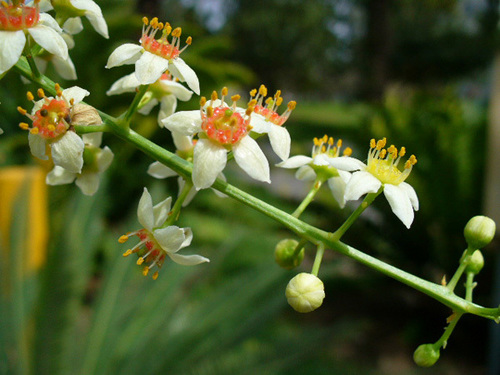
Sources differ on mature height, with the few reported values giving a range of about 150–800 cm. The leaves are compound and odd-pinnate, with leaflets arranged along the rachis; new leaves are finely hairy, and foliage is often concentrated near branch tips. The small flowers are usually yellowish white, greenish white, or pale yellow and occur in axillary inflorescences; the fruit is reported to be a small capsule or capsule-like fruit, described as ridged or divided, obovate, and containing multiple seeds. Growth is slow, and the plant is reported to have a thickened trunk (pachycaul).
Light
Boswellia sacra grows in full sun; indoors, it can be provided with bright light.
Watering
It is suited to dry, well-drained conditions. It is generally reported that, while in leaf, water when the mix has dried.
Temperature and dormancy
Sources differ on the minimum temperature, with the few reported values around 0 °C. It is frost tender; keep above freezing. It drops its leaves and goes dormant. It is reported to have high heat tolerance.
Growing medium and mounting
It needs well-drained, relatively dry soil and is often found on calcareous soils in the wild. It is reported to need a fast-draining mix.
Propagation
It can be propagated from seed or cuttings, and seed germination may be low. Propagation includes cuttings.
Common problems
In wild populations in Oman, heavy animal browsing of leaves, flowers, and seedlings can result in sparse flowering and fruiting and poor regeneration; overharvesting has also been reported as a factor in population decline. The species is adapted to arid, highly exposed rocky slopes and gullies.
Identification
The bark is papery and readily peels, and the plant is rich in resin. On steep rock faces, individuals can develop a conspicuous mound-like or disk-like swelling from the roots to the trunk base that adheres to the rock surface and increases stability.
Photos


Sources
- Wikipedia (en): Boswellia sacra — CC BY-SA 4.0 · link
- Wikipedia (de): Boswellia sacra — CC BY-SA 4.0 · link
- Wikipedia (fr): Arbre à encens — CC BY-SA 4.0 · link
- Wikipedia (es): Boswellia sacra — CC BY-SA 4.0 · link
- LLIFLE Encyclopedia of living forms: Boswellia sacra — CC BY-SA · link
- Useful Tropical/Temperate Plants: Boswellia sacra — CC BY-NC-SA 3.0 (facts only) · link
- Desert-Tropicals: Boswellia sacra — © Philippe Faucon (desert-tropicals.com), facts only · link
- The Succulent Plant Page: Boswellia (genus-level) — © R.J. Hodgkiss, facts only · link
- Top Tropicals catalog: Boswellia sacra — © Top Tropicals LLC (facts only) · link
- Boswellia sacra | Giromagi cactus and succulents | Buy rare plants online (www.giromagi.com) — facts only (§12) · link
- PUKUBOOK: Boswellia sacra — CC BY-NC (facts only) · link