
paperflower (Bougainvillea glabra)
Bougainvillea glabra is a perennial, evergreen to semi-evergreen woody climbing shrub or vine with thorns; it can climb other plants or supports and can also be trained as a shrub, hedge, or bonsai.
Overview
Bougainvillea glabra is a perennial, evergreen to semi-evergreen woody climbing shrub or vine with thorns; it can climb other plants or supports and can also be trained as a shrub, hedge, or bonsai.
Origin and habitat
It is native to South America, with more consistent accounts pointing to Brazil, especially eastern and central Brazil, while other sources extend its native range to Colombia, Peru, Paraguay, and Argentina; sources differ on the range. Its habitats include forests and scrub, including Atlantic rainforest, semideciduous forest, primary forest, and more open secondary vegetation; some accounts associate it with moister soils and elevated sites. It is suited to tropical, subtropical, and warm-temperate environments and is widely cultivated in tropical and subtropical regions; it favors warmth, tolerates heat, becomes drought tolerant once established, and is sensitive to frost.
Characteristics
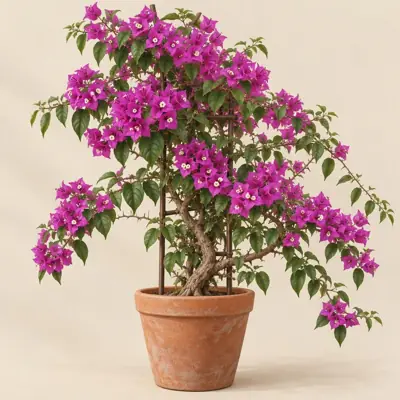
Sources differ on mature height, placing it at about 400–800 cm, while the few available sources report a mature spread of about 250–400 cm. It is reported to grow quickly, with alternate, entire, green to dark-green leaves that are ovate to elliptic or ovate-lanceolate, pointed to tapering at the tip, hairless above, and sometimes sparsely softly hairy below. Sources differ in their descriptions of the flowers: the true flowers are small and tubular, with cream-white to white or pale-yellow inner parts, and are surrounded by conspicuous papery, leaflike bracts commonly ranging from purple and magenta to red, with white, yellow, and orange also occurring. Sources differ on flowering time, which varies with climate and growing conditions; flowering may occur in winter and spring in its native range and southern regions, later in more northern regions or greenhouses, and nearly continuously in warm climates, while RHS identifies summer as the main display period; the fruit is reported to be a small, hairless, spindle-shaped achene that may retain the persistent floral covering and papery, winged bracts.
Light
Full sun is preferred; partial shade is tolerated, but abundant sunlight favors flowering.
Watering
Water thoroughly, then allow the growing medium to dry moderately before watering again; provide more water during active growth and reduce watering from autumn onward, while maintaining good drainage and avoiding prolonged wetness.
Humidity and airflow
It is generally reported to prefer high humidity.
Temperature and dormancy
Sources differ on the lower limit, placing it around -1 °C, while the few available sources report an ideal range of about 18–25 °C and an upper value around 38 °C.
Growing medium and mounting
It requires well-drained soil, but sources differ on soil reaction: NCSU favors acidic soil, whereas RHS describes loam that may be acidic, neutral, or alkaline; containers can use a well-drained, loam-based medium.
Feeding
RHS is reported to recommend a balanced liquid fertilizer after growth resumes in spring, switching to a high-potassium fertilizer when the bracts begin to color and stopping feeding in autumn.
Propagation
It can be propagated by cuttings or layering; RHS notes layering in early spring, semi-ripe cuttings in summer, and hardwood cuttings with bottom heat in winter.
Common problems
Alkaline soil may cause chlorosis, while insufficient light or poor drainage can impair flowering and overall cultivation performance. It is sensitive to frost; sufficiently low temperatures may kill the plant, and after frost causes above-ground dieback, a recovering plant may temporarily stop flowering.
Identification
Its woody climbing branches bear thorns and may hang down, while the true flowers are very small and the main ornamental feature is the papery, colorful bracts. The flower tube is distinctly ridged, distinguishing it from the more rounded flower tube of Bougainvillea spectabilis; the upper leaf surface is usually hairless, whereas B. spectabilis may have a velvety leaf underside.
Photos


Sources
- Wikipedia (en): Bougainvillea glabra — CC BY-SA 4.0 · link
- Wikipedia (de): Kahle Drillingsblume — CC BY-SA 4.0 · link
- Wikipedia (es): Bougainvillea glabra — CC BY-SA 4.0 · link
- GBIF descriptions: Checklist of introduced taxa in Cyprus; Arbolado urbano de Bogotá D.C asociado a servicios ambiental — per dataset · link
- NC State Plant Toolbox: Bougainvillea glabra — copyright (facts only) · link
- Useful Tropical/Temperate Plants: Bougainvillea glabra — CC BY-NC-SA 3.0 (facts only) · link
- RHS Plants: Bougainvillea glabra — © RHS, facts only · link
- USDA PLANTS Database: Bougainvillea glabra — Public domain (US Government work) · link