
great bougainvillea (Bougainvillea spectabilis)
Bougainvillea spectabilis is a perennial. Sources differ in describing its habit as an evergreen woody vine to a climbing, thorny shrub that can attach to other plants or supports with curved thorns.
Overview
Bougainvillea spectabilis is a perennial. Sources differ in describing its habit as an evergreen woody vine to a climbing, thorny shrub that can attach to other plants or supports with curved thorns.
Origin and habitat
Sources differ on its native range: it is native to South America, with Brazil as its core native area, while some accounts also include Bolivia, Peru, and Chubut Province in Argentina. It is reported as native to Brazilian rainforest and also occurs in disturbed environments where introduced. It is suited to tropical, subtropical, and warm-temperate climates, especially environments with a distinct dry season, and is widely cultivated in tropical and subtropical regions worldwide.
Characteristics
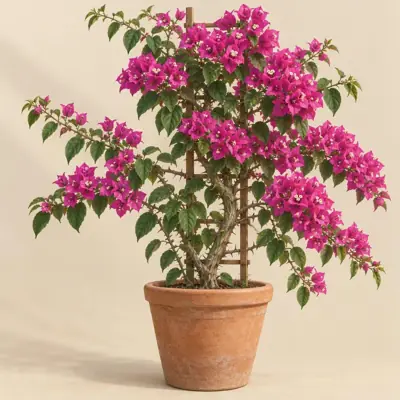
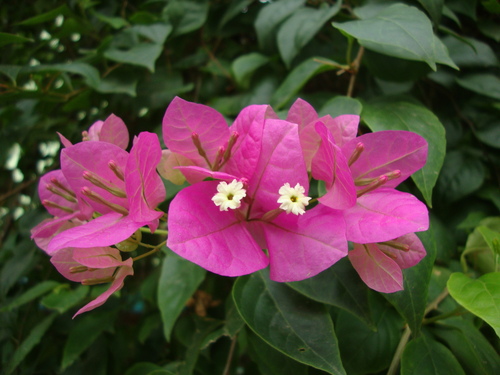
Sources differ on mature height, giving a range of about 1000–1220 cm. Sources differ somewhat in describing the alternate, simple, entire leaves as ovate, elliptic to lanceolate, or sometimes heart-shaped; the leaf surface may be hairy, and the plant can remain evergreen in tropical environments but may be deciduous in temperate regions. Sources differ somewhat in their descriptions, but the true flowers are small and inconspicuous, often white to yellowish white, and are usually surrounded by conspicuous bracts that may be white, red, pink, deep pink, purple, reddish purple, orange, or yellow depending on the cultivar. Flowering mainly extends from spring through autumn and can last longer or continue year-round in warm regions; flowering is more likely after a dry season, while persistently wet conditions may suppress it.
Light
Bougainvillea spectabilis prefers full sun and a sunny position; dark conditions can promote elongated growth and make flowering difficult.
Watering
It prefers relatively dry, well-drained conditions; water thoroughly and then allow the growing medium to dry before watering again. Established plants are drought-tolerant, excessive moisture is unfavorable for flowering, and moderately restricting water in late spring and early summer can encourage flowering.
Temperature and dormancy
It is reported to have a USDA hardiness-zone classification.
Growing medium and mounting
It prefers fertile to moderately fertile, organic-rich, well-drained soil; a soil pH range is also reported by one source.
Feeding
Avoid excessive nitrogen fertilizer, which can favor leaf growth while reducing flowering; fertilizer can be reduced after flowering.
Propagation
Cuttings are the main horticultural propagation method, using either stem or root cuttings; semi-mature stem cuttings can root after a short period. It can also be propagated by air layering or seed, and grafting can be used to produce horticultural plants with different flower or leaf colors.
Common problems
Insufficient light or dark, damp conditions can cause elongated growth and poor flowering, while excessive nitrogen can favor vegetative growth and reduce flowering. It prefers hot, relatively dry climates; persistently wet conditions can impair flowering, and plants in temperate environments may lose their leaves.
Identification
The woody stems have curved thorns and are often densely hairy, while conspicuous large, colorful bracts surround the small flowers. Compared with Bougainvillea glabra, Bougainvillea spectabilis has denser hairs, a rounder floral tube, and longer bracts.
Photos


Sources
- Wikipedia (en): Bougainvillea spectabilis — CC BY-SA 4.0 · link
- 維基百科:叶子花 — CC BY-SA 4.0 · link
- Wikipedia (de): Bougainvillea spectabilis — CC BY-SA 4.0 · link
- Wikipedia (fr): Bougainvillea spectabilis — CC BY-SA 4.0 · link
- Wikipedia (es): Bougainvillea spectabilis — CC BY-SA 4.0 · link
- GBIF descriptions: Checklist of introduced taxa in Cyprus; Catálogo de Plantas y Líquenes de Colombia; The medicinal pl — per dataset · link
- NC State Plant Toolbox: Bougainvillea spectabilis — copyright (facts only) · link
- TaiCOL 臺灣物種名錄: Bougainvillea spectabilis — CC BY 4.0 · link
- 農業知識入口網 植物圖鑑: Bougainvillea spectabilis — © MOA, facts only · link
- Useful Tropical/Temperate Plants: Bougainvillea spectabilis — CC BY-NC-SA 3.0 (facts only) · link
- USDA PLANTS Database: Bougainvillea spectabilis — Public domain (US Government work) · link