
lady of the night orchid (Brassavola nodosa)
Brassavola nodosa is a perennial epiphytic herbaceous orchid.
Overview
Brassavola nodosa is a perennial epiphytic herbaceous orchid.
Origin and habitat
Sources differ in describing its native range, which includes Mexico, Central America, the West Indies, and northern South America, with records from Venezuela, Colombia, Guyana, French Guiana, and Puerto Rico. It occurs as an epiphyte across a range of elevations.
Characteristics
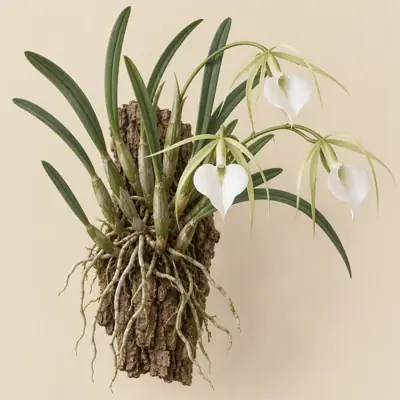
It is reported to form a single leaf on each growth; the leaves are linear-lanceolate to narrowly elongate, thick and rigid or fleshy, gray-green to green, with conspicuous longitudinal grooves. It is reported to bear large, fragrant flowers with slender, tapering sepals and lateral petals ranging from pale green or yellow-green to nearly white; the white lip is tubular around the column at the base and abruptly broadens toward a nearly heart-shaped front, while the tube may have purple or dark red markings. Sources differ on the flowering season, with autumn reported.
Light
It is generally grown in high light.
Watering
It is reported to tolerate drought, with roots adapted to alternating wet and dry periods; mounting on a board can increase airflow around the roots in cultivation. It is generally kept slightly dry.
Humidity and airflow
A limited source reports humidity of about 80–80 %. It generally needs good airflow.
Temperature and dormancy
Brassavola nodosa is warm-growing.
Growing medium and mounting
Brassavola nodosa is epiphytic. Bark is generally preferred as a growing medium.
Identification
It is reported to have slender cylindrical pseudobulbs, a single leaf, slender sepals and petals, and a white lip that is tubular at the base and greatly broadened toward the front; the flowers emit a strong fragrance mainly at night.
Photos


Sources
- Wikipedia (en): Brassavola nodosa — CC BY-SA 4.0 · link
- Wikipedia (ja): ブラッサボラ・ノドサ — CC BY-SA 4.0 · link
- Wikipedia (fr): Brassavola nodosa — CC BY-SA 4.0 · link
- Wikipedia (es): Brassavola nodosa — CC BY-SA 4.0 · link
- GBIF descriptions: Catálogo de Plantas y Líquenes de Colombia; An Updated Checklist of the Orchidaceae of Honduras; Cha — per dataset · link
- USDA PLANTS Database: Brassavola nodosa — Public domain (US Government work) · link
- Internet Orchid Species Photo Encyclopedia: Brassavola nodosa — © Jay Pfahl / IOSPE contributors, facts only · link
- Baker Orchid Species Culture (free sampler): Brassavola nodosa — © Charles O. Baker and Margaret L. Baker (1998), facts only · link