
Paraguay jasmine (Brunfelsia australis)
Brunfelsia australis is an evergreen shrub or small tree. It is reported to be a perennial evergreen woody plant.
Overview
Brunfelsia australis is an evergreen shrub or small tree. It is reported to be a perennial evergreen woody plant.
Origin and habitat
Sources differ on the native range, describing southern South America, including southern Brazil, Paraguay, Argentina, and Uruguay, with more detailed records from Paraná, Rio Grande do Sul, and São Paulo in Brazil and Chaco, Corrientes, Formosa, Misiones, and Santa Fe in Argentina. It is reported to grow in the wild in the understory of low-elevation forests near rivers and at nearby higher sites that are usually not affected by periodic flooding. It is reported to be mainly adapted to subtropical environments and is also cultivated as an ornamental plant in tropical and subtropical regions; sources also report differences in elevation between subtropical settings and tropical areas of Colombia and Ecuador.
Characteristics
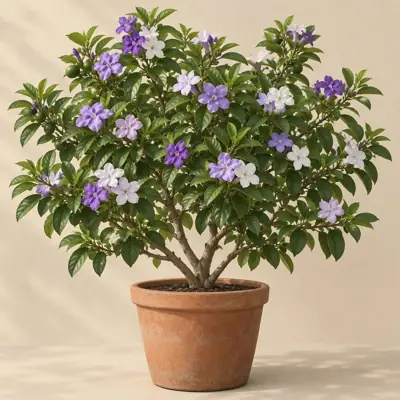
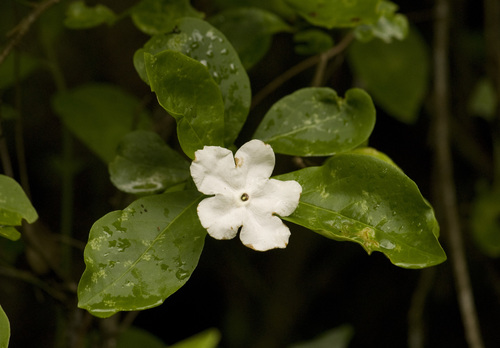
Sources differ on mature height, giving a range of about 200–400 cm. The leaves are distributed along the branches and are reported to range in texture from membranous to nearly leathery, usually broadly elliptic to obovate but sometimes nearly round or rhombic, with mostly obtuse or rounded tips, wedge-shaped bases, dark green upper surfaces, and pale green lower surfaces. Terminal inflorescences bear fragrant flowers that open purple with white to yellow centers, become pale purple, and finally fade to white, so several flower colors can appear on the plant at the same time. Sources differ in their description of the fruit and seeds; the fruit is described as nearly spherical to ovoid, smooth, hairless, and dark green, remaining closed at maturity or opening only very late, while the seeds are described as elongate-elliptic, angular, and dark brown.
Light
Partial shade is considered more suitable, though horticultural sources also accept full sun, bright indoor light, and conditions from partial shade to shade; intense full sun may scorch the leaves and cause them to drop.
Watering
Water regularly, allowing the surface to dry slightly before watering again, while keeping the growing medium moist but well drained.
Temperature and dormancy
A source reports a minimum temperature of about -1.1 °C; sources are few. It is generally assigned a USDA hardiness zone and is reported to tolerate brief light frost.
Growing medium and mounting
It is reported to prefer loamy, fertile, humus-rich soil that is moist but well drained; many plants in the genus can grow in alkaline soil, and adding ground limestone can be beneficial in non-alkaline soil.
Propagation
It is reported to be propagated by seed, layering, and division of root suckers. The seeds are reported to be short-lived and intolerant of drying, so fresh sowing is preferred, with fresh seeds reported to germinate after a period of several weeks.
Common problems
Intense full sun is reported to cause leaf scorch and leaf drop. Mature plants tolerate only brief light frost, young plants require protection from cold, and intense sunlight may also scorch the leaves.
Identification
A conspicuous feature of Brunfelsia australis is its fragrant flowers, which change from purple to pale purple and finally white as they age, allowing several flower colors to appear simultaneously; the plant has the form of a shrub or small tree.
Photos


Sources
- Wikipedia (en, genus): Brunfelsia — CC BY-SA 4.0 · link
- Wikipedia (de): Brunfelsia australis — CC BY-SA 4.0 · link
- Wikipedia (es): Brunfelsia australis — CC BY-SA 4.0 · link
- GBIF descriptions: Lista de especies de plantas exóticas y trasplantadas de Colombia; Catálogo de Plantas y Líquenes de — per dataset · link
- Useful Tropical/Temperate Plants: Brunfelsia australis — CC BY-NC-SA 3.0 (facts only) · link
- Top Tropicals catalog: Brunfelsia australis — © Top Tropicals LLC (facts only) · link